6Sense Tells You Who and When. Who’s Telling You What to Send?

If you're running ABM on 6Sense, you're not short on signal. Intent scores, buying stage, keyword surges, account engagement, all of it arriving in more granular detail than most GTM teams know what to do with. The platform side of ABM has gotten genuinely good. The problem almost nobody talks about openly is what happens after the signal fires.
Most teams take that intent data and route it into the same execution motion they'd use for a cold list: a sequence, a template, a merge field for company name. The signal told you something specific just happened. The email that goes out treats it like nothing happened at all. That gap, rich data in, generic execution out, is the actual bottleneck in most ABM programs today. It's not a targeting problem. 6Sense already solved targeting. It's a conversion problem: turning a signal into something that reads like someone actually understood it.
6Sense's own Conversational Email capability is a reasonable answer to part of that gap, and it's worth being fair about what it does well: it's native to the platform, it can generate email copy tied to intent data without leaving the workflow, and for teams that need something fast and built-in, it closes some of the distance between signal and send. But there's a structural ceiling to what a built-in email generator inside an intent platform can produce, and it's worth naming plainly instead of glossing over it.
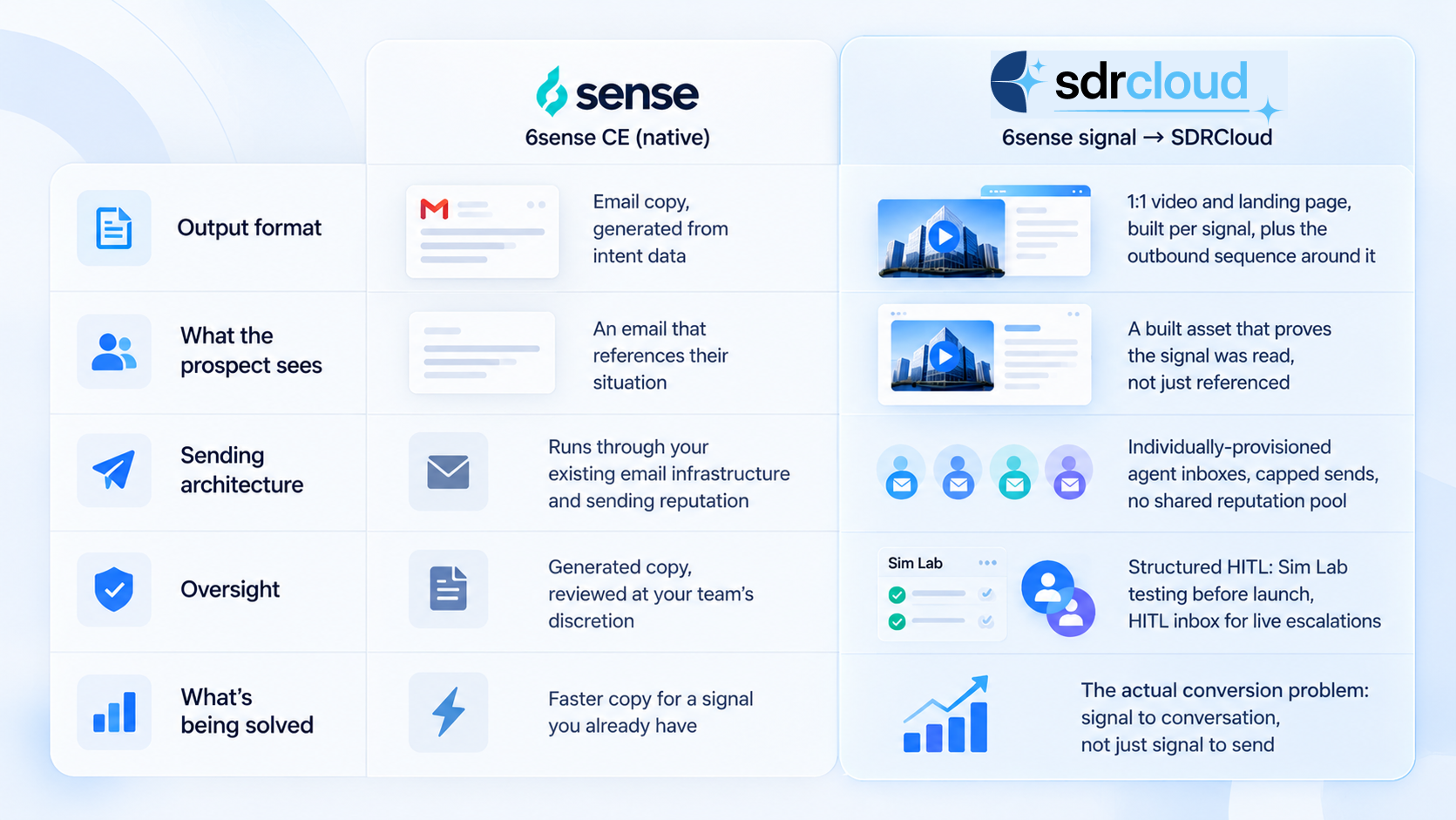
The core difference isn't email quality. It's asset type. An email, however well the copy is generated, is still an email: text in an inbox, competing with everything else in that inbox, asking the recipient to imagine the specificity rather than see it. A 1:1 video and landing page, built for that exact signal, is something the recipient can watch and click through, and its existence is itself the proof that someone, or something, actually processed what 6Sense surfaced about them. That's a different kind of first impression than a well-written sentence.
This isn't an argument for replacing what 6Sense already does inside your ABM motion. Intent scoring, account prioritization, buying-stage detection, that's the layer that tells you who and when, and it's the reason the signal exists to act on at all. What SDRCloud adds is the layer 6Sense was never built to be: the execution engine that takes what 6Sense surfaced and turns it into something a prospect experiences as a real conversation starter, not a well-targeted email.
Think of it as the difference between knowing exactly which account just hit a buying-stage threshold, and knowing exactly what to put in front of that account's buyer in the next ten minutes that would make them want to respond. 6Sense answers the first question better than almost anything on the market. SDRCloud is built specifically to answer the second one.
If your team is already sitting on 6Sense data that's more sophisticated than what your outbound execution is doing with it, that gap is the actual growth lever most ABM programs are leaving unaddressed. The signal was never the hard part. What you do with it in the next email is.