Email Was the Original 1:1 Channel. Somewhere Along the Way, It Stopped Acting Like One.
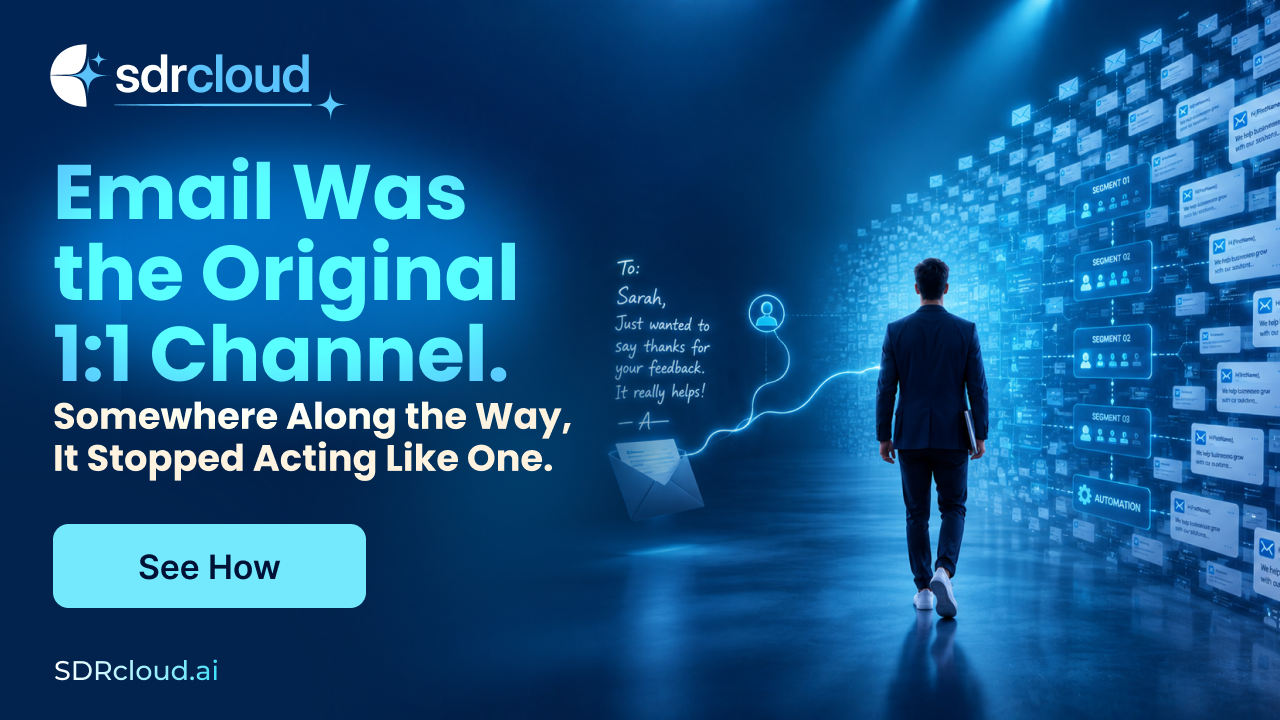
Before anyone called it a channel, email was just a message from one person to another. No merge fields, no segments, no send-time optimization. Somewhere in the scaling of that idea into an entire discipline, the industry solved for volume and quietly lost the thing that made email worth sending in the first place: it used to feel like it was actually from someone, about something specific to you.
Every email marketer reading this already knows the tension, because you live inside it daily. The tools got better. The segmentation got sharper. The deliverability science got genuinely sophisticated. And the actual experience on the receiving end, for most of what gets sent, still reads as a broadcast wearing a first name. You've been asked to do more with the same fundamental unit, a templated message with variables swapped in, for over a decade, and the returns on that approach have been quietly flattening the whole time.
We think email marketing doesn't need another optimization layer. It needs to be rebuilt around a different unit entirely.
What we actually reimagined, and why it isn't just "AI-personalized email"
Every AI vendor in this space is currently promising smarter copy, better subject lines, sharper send-time prediction, all still producing the same underlying artifact: a text email, optimized. We built something categorically different. Instead of optimizing the email, the Asset Factory replaces it as the unit of execution. A signal, a specific behavior, life event, or intent trigger, produces a genuine 1:1 video and landing page, not a smarter paragraph of text. The email becomes the doorway to something built specifically for that moment, instead of being the entire deliverable itself.
That's not a bigger claim about personalization. It's a different starting premise about what email marketing is even trying to produce.
What this looks like across three completely different worlds
B2B: A signal, an opportunity stage change, a specific technographic pattern, a piece of content engagement, triggers a 1:1 asset built around that exact context, not a nurture template with a company name inserted. The email doesn't try to do all the convincing itself. It's the entry point to an experience built specifically for what that account is dealing with right now.
B2C: A life event, a cart abandonment with real intent behind it, a browsing pattern that signals genuine purchase consideration, a renewal window approaching, becomes the trigger for something built around that specific moment in someone's life, not a generic promotional blast synced to a calendar date. The difference between "here's this week's sale" and "here's something built around the exact thing you were just looking at" is the difference between an email that gets deleted and one that gets opened because it's clearly about something real.
Recruitment marketing: A candidate signal, a profile update, engagement with a specific job category, a life stage that implies career movement, triggers outreach built around that specific opportunity and that specific candidate's apparent interest, not a templated "we're hiring" blast sent to an entire talent pool regardless of fit or timing. Recruitment email has some of the worst reputation for generic blasting in the entire category. It's also one of the clearest cases for why a built, specific asset outperforms a broadcast: nobody responds to a job posting that could have gone to anyone, and most of them read exactly like they did.
Three completely different worlds. Same underlying principle: the signal decides what gets built, not a template deciding what gets sent to everyone who happens to match a segment.
We want to build this with the people who actually understand email, not around them
Here's the honest admission underneath this piece: we didn't build the Asset Factory by starting from deep expertise in email marketing specifically. We built it by starting from a category-level critique of what execution had become, across outbound broadly. Email marketers have spent careers inside the actual mechanics, deliverability, list health, segmentation logic, the real behavioral patterns that separate what converts from what gets ignored, in ways we respect and want to build alongside, not replace with a platform that assumes it already knows better.
That's the actual invitation here. We're looking for email marketers who want to partner with us, not as customers evaluating a tool, but as people who've spent years understanding what a real audience actually responds to, and who are frustrated by the same gap we are: knowing your list deserves better than a template, and not having an execution layer built to deliver on that.
So here's the actual question, and we mean it as a real one, not a rhetorical setup for a pitch:
If you could reimagine email marketing with none of today's constraints, no legacy ESP architecture, no assumption that a template with merge fields is the ceiling of what's possible, what would you actually build? What would the unit of a "send" look like if it wasn't required to be a static block of text? What would B2C, B2B, or recruitment email look like if every send could be as specific as the best 1:1 conversation your best rep or recruiter ever had, at a volume no single person could sustain?
We have a real point of view on that question, and it's not finished. If you've spent your career in email and you've felt the same gap between what the channel could be and what it's currently allowed to be, we'd rather build the answer with you than hand you a platform and call it solved.