The Case for Staying in Sales Longer — and the Infrastructure That Makes It Possible

Most founders hear the same advice early: hire sales as soon as possible.
Get out of the day-to-day. Build the team. Scale the motion.
The logic sounds reasonable. But in practice, many founders discover something uncomfortable after they step back: close rates fall, sales cycles lengthen, and deals that once felt natural suddenly become harder to win.
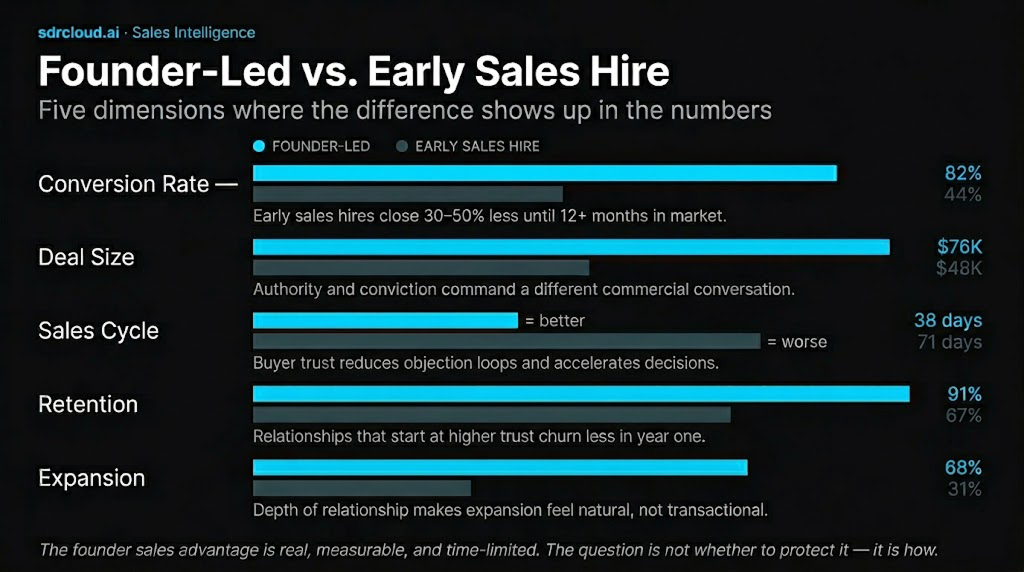
The pattern is remarkably consistent across B2B companies. Founder-led sales often produces:
- Higher conversion rates
- Larger deal sizes
- Faster trust with buyers
- Better long-term customer relationships
The problem is not that founders should stay in sales forever.
The problem is that most founders exit before the motion is stable enough to survive without them.
Founder-led sales is not unsustainable because founders are bad at delegating. It becomes unsustainable because there is usually no infrastructure supporting the founder behind the scenes.
That infrastructure gap is what SDRCloud exists to solve.
Why Founder-Led Sales Actually Works
Founders outperform early sales hires for reasons that are difficult to replicate through onboarding alone.
Conviction is one of them. Buyers can feel the difference between someone explaining a company and someone who built it.
Founders also understand the customer problem at a depth few hires can match early on. They know why the product exists, what tradeoffs were made, and what the customer is truly trying to solve.
That changes the conversation.
Founder outreach gets opened because it carries authority. Founder conversations progress because they carry specificity. And customers who buy directly from founders often stay longer because the relationship begins with a higher level of trust.
This is not founder mythology. It is a repeated pattern in B2B sales.
Founder-led sales works because founders bring something to the process that cannot easily be hired for in the early stages: direct ownership of the problem and genuine conviction in the solution.
Why Founders Exit Sales Too Early
Most founders do not leave sales because it stopped working.
They leave because it became exhausting.
Manual outreach, constant follow-up, maintaining pipeline, running meetings, managing the company — eventually the workload becomes unsustainable.
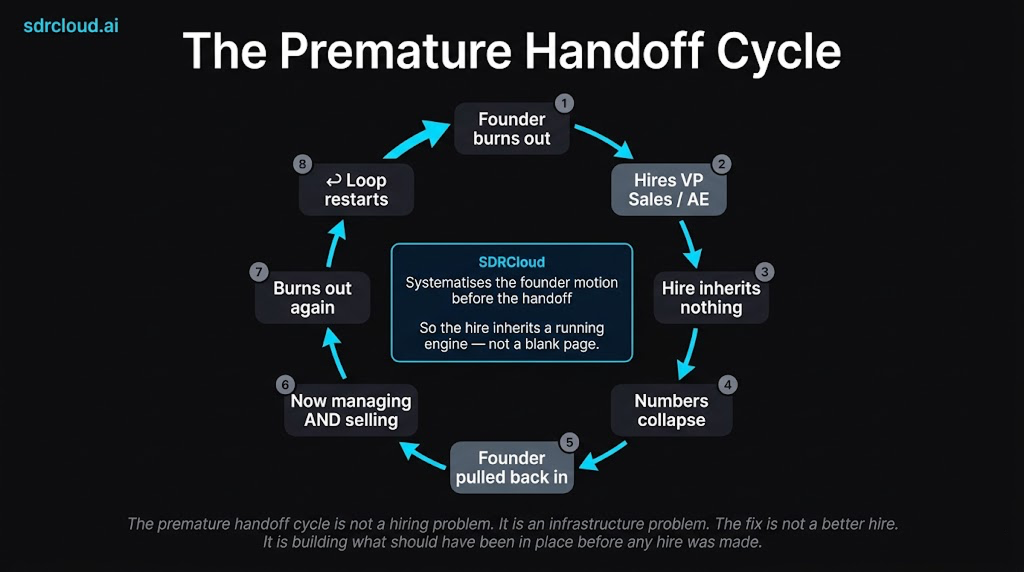
At that point, the founder hires a VP of Sales or an early AE hoping the motion will scale.
What often happens instead is predictable:
- The hire inherits an undocumented process
- Close rates drop
- Pipeline quality declines
- The founder gets pulled back into strategic deals anyway
Now the founder is doing two jobs: running sales and managing the person meant to replace them.
The handoff didn’t fail because the hire was wrong.
It failed because the founder motion was never systematised in the first place.
What Founder-Led Sales Actually Needs to Scale
The founder’s ability to sell is rarely the real bottleneck.
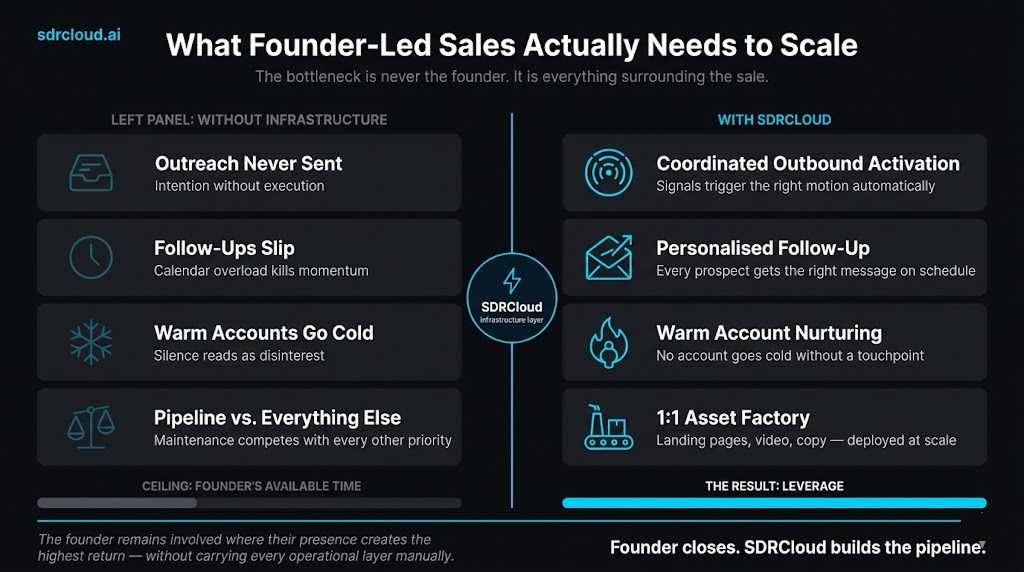
The bottleneck is everything surrounding the sale:
- Outreach that never gets sent
- Follow-ups that slip because the calendar is overloaded
- Warm accounts that quietly go cold
- Pipeline maintenance that competes with every other founder responsibility
Without infrastructure, founder-led sales has a hard ceiling: the founder’s available time.
That is where SDRCloud changes the equation.
The founder’s role should be to close high-value conversations. SDRCloud’s role is to build and maintain the pipeline around them:
- Coordinated outbound activation
- Personalised follow-up
- Warm account nurturing
- 1:1 outreach infrastructure powered by the Asset Factory
The result is leverage.
The founder remains involved where their presence creates the highest return — without carrying every operational layer manually.
When to Stay In, When to Step Back, and How to Know the Difference
The goal is not for founders to stay inside every deal forever.
The better question is: where does founder involvement create disproportionate value?
That usually includes:
- Strategic enterprise accounts
- Complex buying committees
- High-trust partnership conversations
- Deals where founder presence signals commitment
Founder time should be concentrated where it materially changes outcomes.
The rest of the motion should be supported by infrastructure capable of maintaining relationship quality, follow-up discipline, and pipeline momentum at scale.
This is not “founder-led or sales team.”
It is founder-led where it matters most — with an engine running behind it.
Founder-led sales is worth protecting because the advantage is real.
Founders often close more effectively, build deeper trust, and create stronger long-term customer relationships than early sales hires can replicate.
What makes founder-led sales difficult is not the selling itself. It is the absence of infrastructure around it.
The outbound engine. The follow-up system. The account activation layer. The operational support that turns founder sales from a personal effort into a scalable motion.
That is what SDRCloud provides.
The founders who build that infrastructure early tend to sell more effectively, burn out less frequently, and hand off sales more successfully when the time finally comes.
Not because they worked harder.
Because they stopped relying on calendar hours alone to carry the entire motion.