The Margin Your BPO Is Leaving on the Table Every Time You Hire Another SDR

If you run a BPO that sells sales outsourcing, you already know the real cost of your outbound service line. It isn't the number on your rate card.
It's everything underneath it:
- Recruiting an SDR
- Training them on a new client's product in week one
- Watching output climb slowly over the first month while they ramp
- Doing it all again six months later when they burn out or move on
That cost structure is baked into every engagement you run, whether you price it in or absorb it as overhead.
Here's the part that doesn't get said out loud enough: none of that cost is buying your clients better outbound. It's buying you the ability to staff outbound at all. You can win a bigger client. You can't instantly produce three more trained, ramped SDRs to serve them.
Three Ways to Run SDRCloud Inside Your BPO
SDRCloud isn't a single service line. It's an execution layer your BPO applies across three distinct use cases, each solving a different margin or capacity problem.
1. Client AcquisitionYour own new-business pipeline. Instead of your BPO's growth being capped by how fast you can staff your own outbound team, SDRCloud runs the outreach that fills your sales pipeline, so your growth isn't gated by your own hiring the same way your clients' growth used to be gated by theirs.
2. Talent AcquisitionIf your BPO also runs recruitment or staffing engagements, the same signal-triggered execution applies to candidate outreach: a specific role, a specific candidate signal, a specific reason to reach out now, instead of a generic "we're hiring" blast run against a static talent pool.
3. Outbound-as-a-ServiceThe core sales outsourcing engagement most BPOs already run. Your team operates the platform on behalf of clients, delivering the same outbound service you sell today, at a cost structure that doesn't scale linearly with headcount.
Internally, the seat running these campaigns is called a Campaign Creator, a role your team operates directly, distinct from the outward-facing language used elsewhere in our partner ecosystem.
Same Service. Different Cost Structure.
SDRCloud exists as a line item you add to what you already run, not a replacement for the service you already sell.
Your team stays exactly where it is. What changes is what's underneath their hands: instead of every touch requiring a human to research, write, and send it, your team operates agents that handle execution while your people apply judgment where it actually matters.
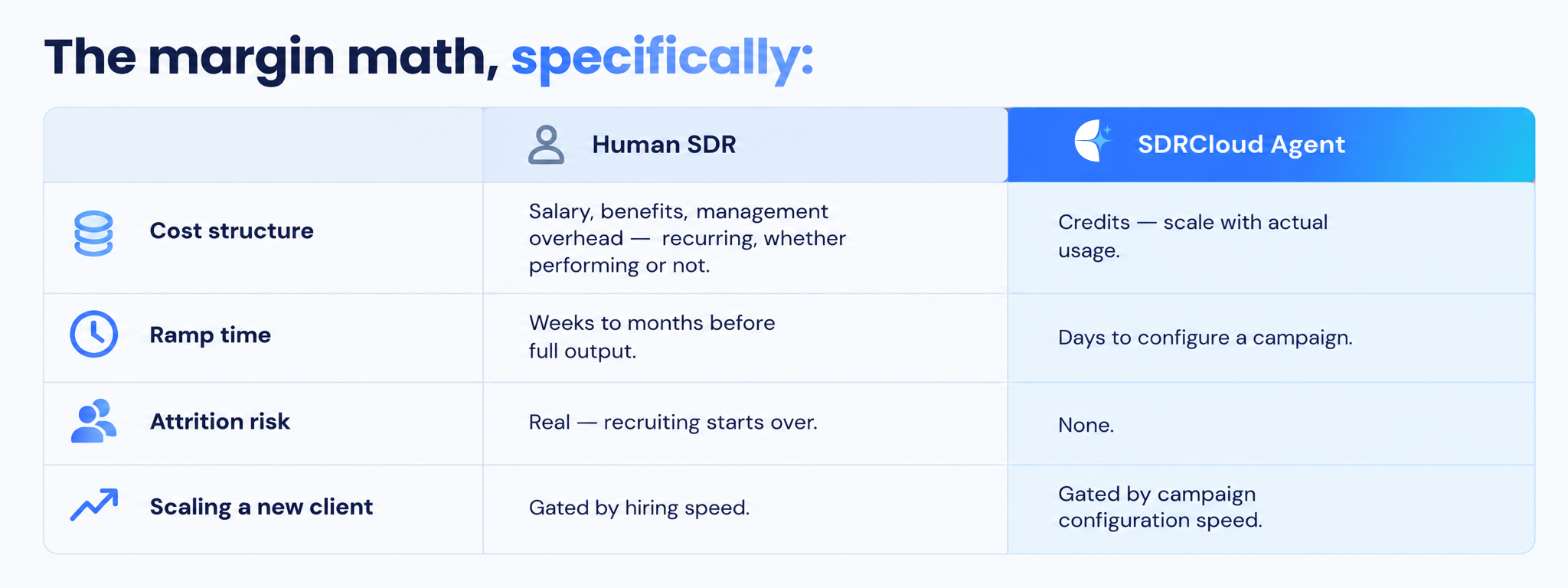
Every engagement you run with agents instead of an equivalent headcount hire is margin you weren't capturing before, on a service you were already delivering.
Disclosed, Not Hidden
This isn't a black-box tool your clients discover later and wonder why it wasn't disclosed.
SDRCloud is a technology layer your team operates, and your clients know it's running underneath the engagement, the same way clients already know which CRM or engagement platform an agency uses without that disclosure undermining the relationship.
What clients are still paying for: your team's strategy, judgment, and account management.
What's different underneath it: an execution layer producing more volume, more consistently, than a comparable human team could produce alone.
What This Changes About the Conversations You're Willing to Have
Standing up a new sales outsourcing engagement the old way means recruiting and training before you can deliver anything. Weeks before a new client sees real output. Real risk if the hire doesn't work out.
Standing up the same engagement with agents in the mix means you're not gated by how fast you can hire. You're gated by how fast you can configure a campaign, days, not months.
That changes which client conversations you're willing to have at all, because the cost of saying yes to a smaller or faster-turnaround engagement just dropped.
The Actual Decision
Every sales outsourcing engagement your BPO runs today has a margin ceiling set by human execution costs that haven't changed in years, no matter how good your recruiting or training process gets.
Adding SDRCloud as the execution layer underneath your existing service doesn't change what you sell. It changes what that engagement costs you to deliver, on every client, for as long as you run it, across client acquisition, talent acquisition, and outbound-as-a-service alike.
If you're already running outbound teams for clients, the question isn't whether there's room to add this. It's how much margin your BPO has been giving up on every engagement you're already running, waiting for a hiring problem to solve itself.