The SDR Model Was Built for a Different Era. Here Is the Commercial Case for What Comes Next.
The SDR model was a genuine innovation when it emerged.
Separating prospecting from closing allowed sales teams to specialise. Pipeline generation became operationalised. Outbound scaled with headcount. For more than a decade, the model made commercial sense.
But the conditions that made it effective have changed.
Buyer inboxes are saturated. Response rates continue to decline. SDR attrition remains high. Ramp periods remain expensive. And the technology capable of replacing many of the model’s core functions has matured rapidly.
This is not an argument that SDRs are ineffective people.
It is an argument that revenue leaders need to reassess whether the system surrounding them still makes commercial sense.
What the SDR Model Actually Costs
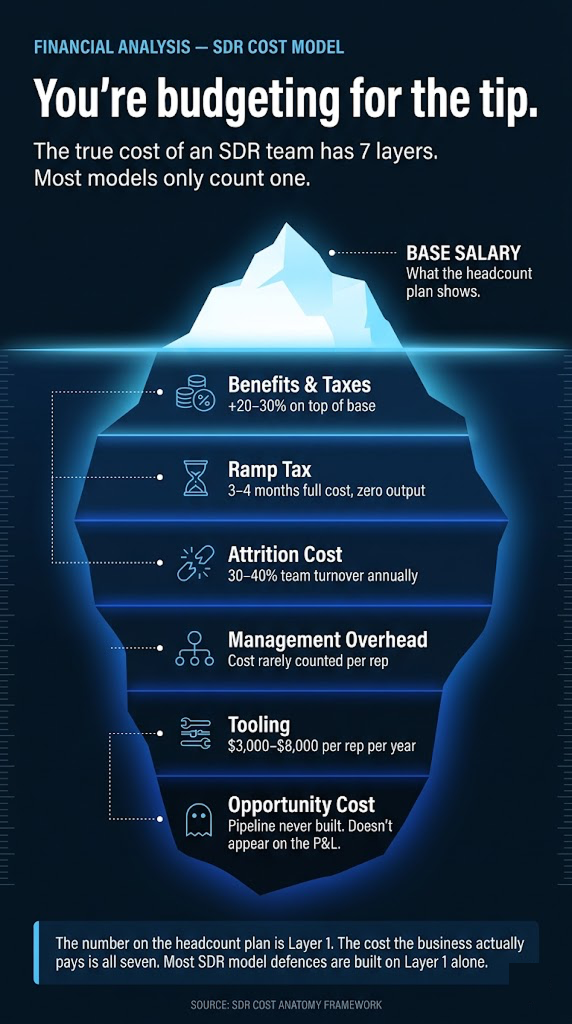
Most organisations underestimate the real cost of an SDR team because they calculate only the visible layer: salary.
The actual economics are broader:
- Ramp time
- Attrition
- Management overhead
- Tooling costs
- Pipeline inconsistency during hiring cycles
A new SDR may require several months before producing stable output. If turnover occurs annually — as it frequently does — that ramp cost repeats continuously across the organisation.
Then there is the hardest cost to measure: pipeline that was never created because a territory was uncovered, a rep underperformed, or follow-up quality declined during transition periods.
The cumulative effect is that the true cost per qualified meeting is often materially higher than leadership teams initially believe.
The Output Problem
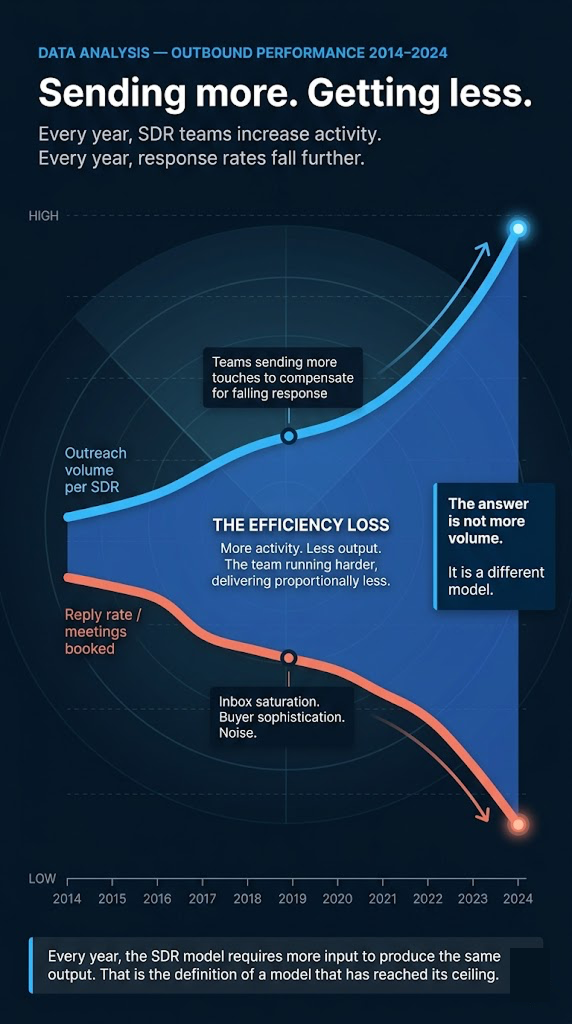
At the same time costs have risen, outbound effectiveness has weakened.
Reply rates to cold outbound have declined steadily for years. Buyers are more selective, more inbox-aware, and less responsive to high-volume sequencing than they once were.
The industry response has largely been predictable: increase activity volume.
More touches. More sequences. More automation.
But increasing outbound volume has also intensified the saturation problem that reduced effectiveness in the first place.
The model is now often operating harder simply to maintain the same level of output.
That is not operational optimisation. It is diminishing efficiency.
What Time to First Meeting Actually Measures
Most outbound metrics are indirect indicators:
- Open rates
- Reply rates
- Sequence completion
- Touch volume
The metric that matters most is simpler: time to first qualified meeting.
That is the moment activity becomes pipeline.
Time to first meeting reflects the combined effectiveness of:
- Targeting quality
- Message relevance
- Follow-up consistency
- Buyer intent
- Outreach timing
A model that consistently reaches qualified meetings faster is not simply operating more efficiently. It is operating with higher-quality inputs throughout the sales process.
This is where the distinction between traditional SDR workflows and SDRCloud becomes structurally significant.
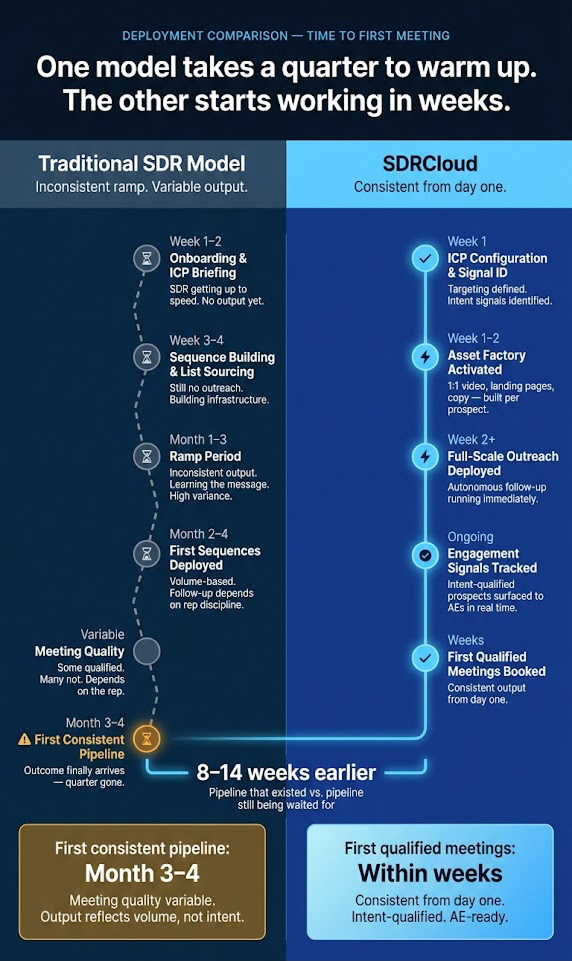
The gap between these two paths is not a marginal efficiency improvement. It is the difference between a model that takes a quarter to reach full output and one that starts producing pipeline in weeks.
The AE Productivity Argument
The commercial case for SDRCloud is not only about reducing SDR-related cost.
It is also about improving the effectiveness of Account Executives.
When prospects arrive already engaged — having interacted with personalised landing pages, watched contextual videos, or demonstrated intent through engagement signals — the first conversation changes materially.
Discovery becomes shorter. Qualification becomes clearer. Conversations begin at a more advanced stage of buyer consideration.
The AE spends less time compensating for low-context outreach and more time applying judgment where it matters most:
- Complex buying decisions
- Stakeholder alignment
- Commercial negotiation
- Strategic relationship building
This improves the productivity of the closing team without requiring proportional increases in pipeline-generation headcount.
The SDR model was rational for the environment it was built in.
But every outbound system eventually reaches the limits of its underlying economics.
Today, many revenue organisations are operating a model that requires:
- Increasing activity volume
- Continuous hiring and ramping
- Persistent management overhead
- Rising cost per meeting
…while overall outbound effectiveness continues to decline.
The honest commercial question is no longer whether the SDR model has weaknesses.
It is whether continuing to scale that model remains the best use of capital.
SDRCloud offers a different approach:
- Less dependence on ramp-heavy headcount
- Faster time to first qualified meeting
- Pipeline driven by engagement and intent signals
- A closing team supported by higher-quality outbound infrastructure
The advantage is not marginal.
It is structural.