What Comes After Broadcast
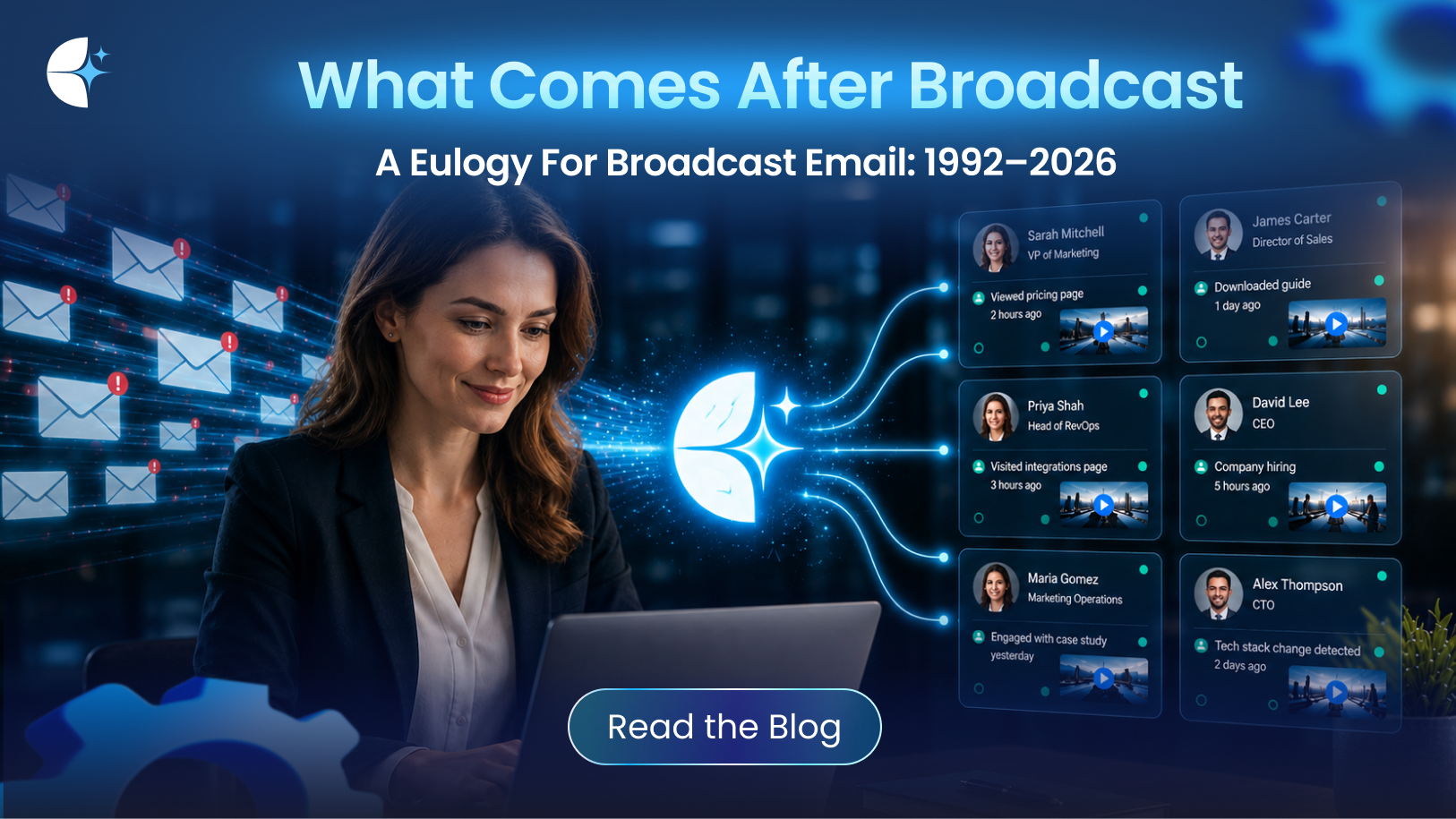
There's a moment at every funeral where the mourners walk out of the chapel, blinking in the daylight, and someone finally asks the question the eulogy was too polite to answer: okay, but what do we actually do now?
We've been waiting a long time to answer that question.
If you read the eulogy, you know the diagnosis already. Broadcast Email didn't die of spam filters or crowded inboxes, not really. Those were symptoms. It died because it asked the wrong question at scale, forever: how do we say this to everyone, instead of does this one person want to hear from us right now. Every "optimization" the industry threw at it — subject line tests, send-time algorithms, AI copy at volume — was a way of getting better at the wrong question. You can't out-engineer a category error.
We noticed this early, and not because we were smarter than anyone else in the room. We noticed it because we were building outbound campaigns ourselves and kept running into the same wall: the moment you personalize with a token instead of a signal, you haven't built a relationship, you've built a mail merge with better manners. A first name in a subject line was never going to fix a system that had nothing real to say to the person receiving it.
So we built the thing we wished existed instead.
Meaning, not sending
The core bet behind SDRCloud is simple to state and hard to build: the channel isn't the product anymore. Sending was never the hard part — anyone can send. The hard part, the part that actually earns attention, is building something that's true for exactly one prospect, based on exactly what they've done and exactly what moment they're in.
That's the job of our Asset Factory — it generates a 1:1 landing page and a 1:1 video per prospect signal, not a template with variables swapped in. It's the difference between a form letter and a person who did their homework before showing up. One of those gets archived before it renders. The other gets a reply.
Underneath that sits Logic Studio, the visual, node-based system that decides when and why a given prospect gets a given asset — trained not on a generic script, but on the specific signals that matter for that campaign, that account, that moment. It's the infrastructure that lets "does this person want to hear from me right now" scale past the size of a single very good SDR's memory.
The part we refused to automate away
Here's where we differ from a lot of what got built in the AI-SDR gold rush of the last few years: we didn't try to remove the human. We tried to remove the busywork.
The industry has watched several fully autonomous AI SDR models fail publicly — badly, in ways that torched trust with the very buyers they were supposed to win over. That wasn't a bug in the concept of AI-driven outbound. It was a bet that the human layer was overhead instead of the point. We think it's the point. An AI system can read a thousand signals a human never could. It cannot decide, on its own, that a message is actually ready to go out under your name. That's still a judgment call, and judgment calls belong to people.
So Human-in-the-Loop isn't a compliance checkbox bolted onto our platform. It's structural. The AI does the reading — the signal detection, the asset generation, the sequencing logic. The human decides what actually leaves the building. In a market that just watched what happens when nobody's holding the wheel, that's not a limitation. It's the whole argument.
The eulogy's real thesis
Go back to the closing line of the eulogy: the future is already here, it just doesn't broadcast.
That's not a slogan. It's a description of a mechanical difference. Broadcast email had one message and many recipients. What we build has as many messages as there are prospects who deserve one — each built from their own signal, delivered by an AI that did the reading and a human who did the deciding, at a scale that used to require an army and now requires a platform.
The old model asked how loud you could get. The new one asks how relevant you can be, to one person, right now — and then does that again, and again, without ever going back to shouting.
Broadcast Email had a good, loud, crowded run. It's buried now. What comes after it isn't another channel. It's a posture — and it's the one we've been building toward the whole time.