Why "Dear Member" May Cost Barnes & Noble Its Most Loyal Customers
Barnes & Noble knows I'm a Maggie O'Farrell reader.
They know because I've bought four of her books through my rewards account. Hamnet. The Marriage Portrait. I Am I Am I Am. The Hand That First Held Mine. Four purchases. Four clear data points. An unmistakeable pattern in any CRM worth its monthly subscription.
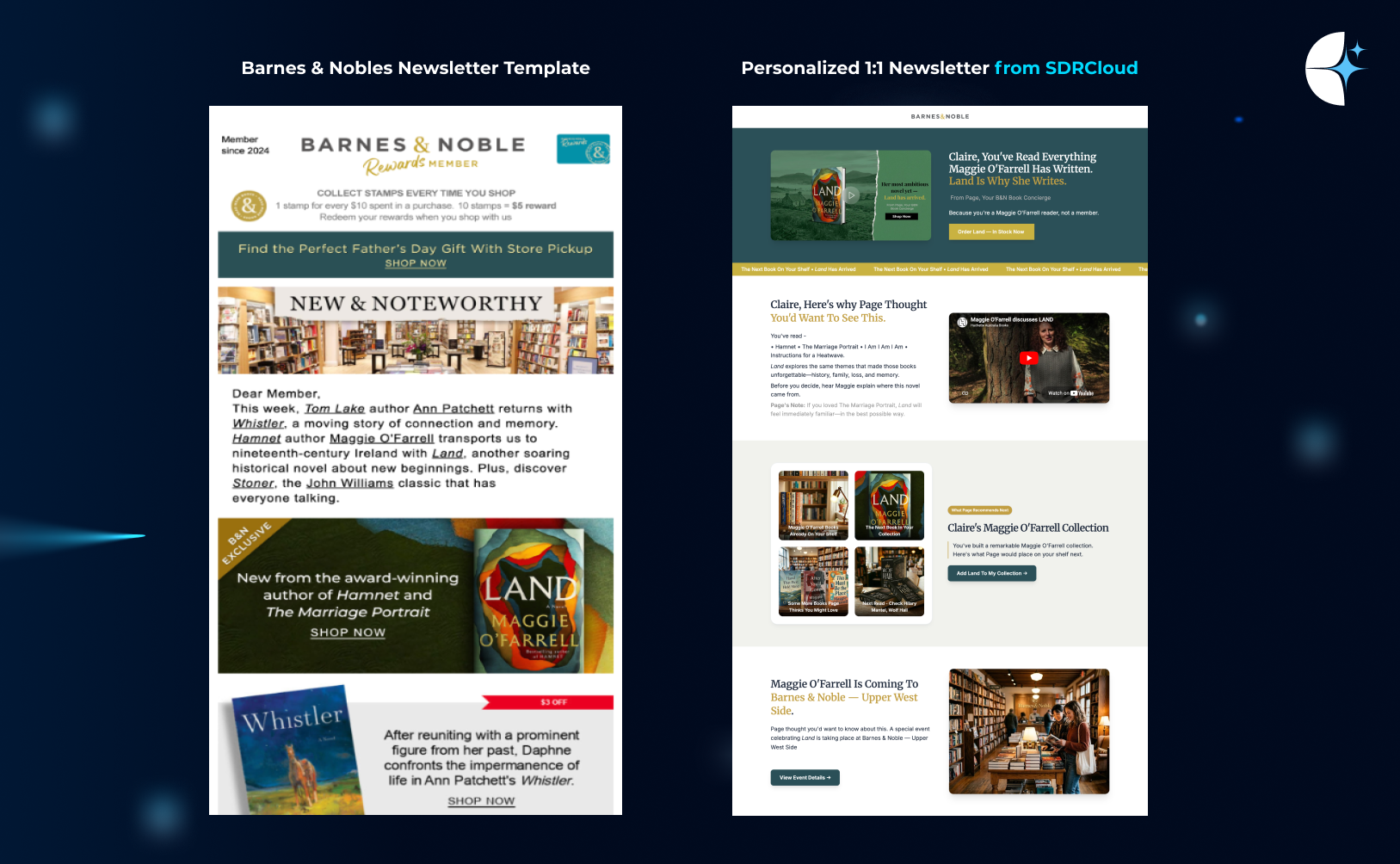
And yet, when Maggie O'Farrell's new novel Land arrived — the book she has been building toward for 25 years, set in post-Famine Ireland, already one of the most anticipated literary fiction releases of 2026 — Barnes & Noble sent me this:
"Dear Member, This week, Tom Lake author Ann Patchett returns with Whistler, a moving story of connection and memory. Hamnet author Maggie O'Farrell transports us to nineteenth-century Ireland with Land..."
Dear Member.
They buried Land — the exact book I would pre-order without hesitation — between a Father's Day gift guide and a $3 off badge on a Hitchcock retelling. They addressed me as "Member." They sent the same email to four million people who have never read a word of Maggie O'Farrell's work and to me, who has read nearly everything she has written.
This is not a personalisation problem. Barnes & Noble has every piece of data they need. This is an execution problem. And it is costing them — and every major B2C brand running broadcast email — a measurable, predictable, completely avoidable revenue gap.
The Broadcast Model Is Broken. The Data to Fix It Already Exists.
The average B2C email campaign achieves a click-through rate of around 2.5%. That means 97.5% of every email sent produces no commercial action. Brands have accepted this as the natural ceiling of email marketing. It is not. It is the ceiling of broadcast email — the model where the same message goes to every subscriber regardless of what they have actually bought, read, watched, or engaged with.
The data to do better already lives in every major retailer's loyalty programme. Every purchase. Every browse. Every category preference. Every moment a member engaged with a notification and every moment they ignored one. It is all there. Barnes & Noble has it. Sephora has it. Every major book, beauty, spirits, and apparel retailer is sitting on a purchase history database that, if actually used to drive email content, would transform their conversion numbers.
The reason it does not get used is that personalisation at this depth has historically required custom engineering, expensive enterprise CDP deployments, and months of implementation work. One email per segment is achievable. One email per member — genuinely 1:1, built from their specific history, in a voice that matches the register of what they love — has not been.
Until now.
What a 1:1 B2C Email Actually Looks Like
SDRCloud's Conversational Commerce infrastructure was built for B2B outbound. But the same Asset Factory that produces a 1:1 landing page and a 1:1 video for every prospect in a corporate outbound campaign produces the same thing for every member in a B2C loyalty programme. The mechanism is identical. The purchase history is the signal. The signal drives the content. The content arrives as a 1:1 experience — not a template with a name dropped in, but a page and a message built specifically from what that member has actually done.
Here is what that looks like for a Barnes & Noble Maggie O'Farrell reader, versus the email they actually received.
The B&N Version (What Happened)
Opening: "Dear Member" — no first name
Land buried in the third paragraph, after Ann Patchett
Same email sent to millions of members with no O'Farrell purchase history
Discount badges ("$3 OFF") as the primary hook
No reference to the reader's existing O'Farrell library
No author voice, no editorial recommendation, no relationship
The SDRCloud Version (What Should Have Happened)
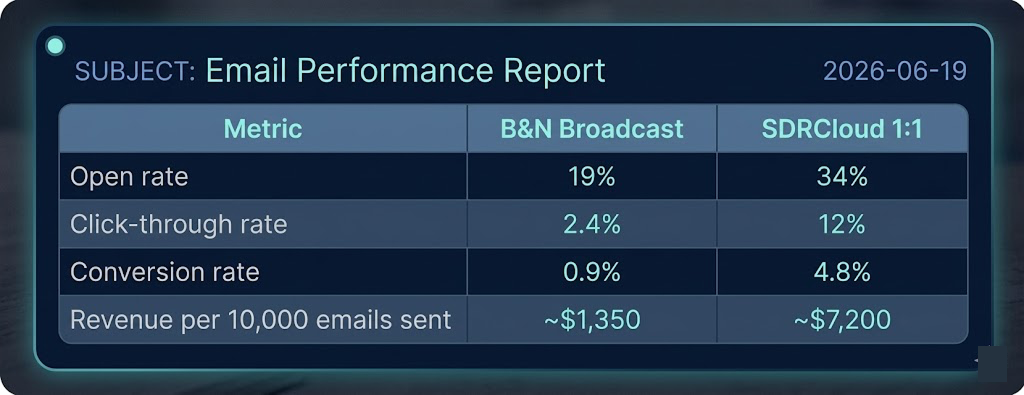
The email opens: "Emma, Maggie O'Farrell's new novel is here. And based on what you've read, this one is made for you."
The landing page references the specific books the reader owns — Hamnet, The Marriage Portrait — and draws the bridge to Land's themes directly. It surfaces Maggie O'Farrell's own publisher video, framed with the reader's name as an address before it plays. It recommends Sebastian Barry's On Canaan's Side as a companion read for readers who loved Land's Irish historical setting. It surfaces the reader's rewards points with a specific redemption suggestion: "put them toward Land in hardback — it's exactly the kind of book you should own, not borrow." It is signed by "Page, Your B&N Book Concierge" — a consistent voice that builds a relationship across every subsequent touch.
The email does not exist for four million people. It exists for one person who has demonstrated, through four purchases, exactly what they love.
The Conversion Rate Prediction
This is where the analysis gets commercially interesting.
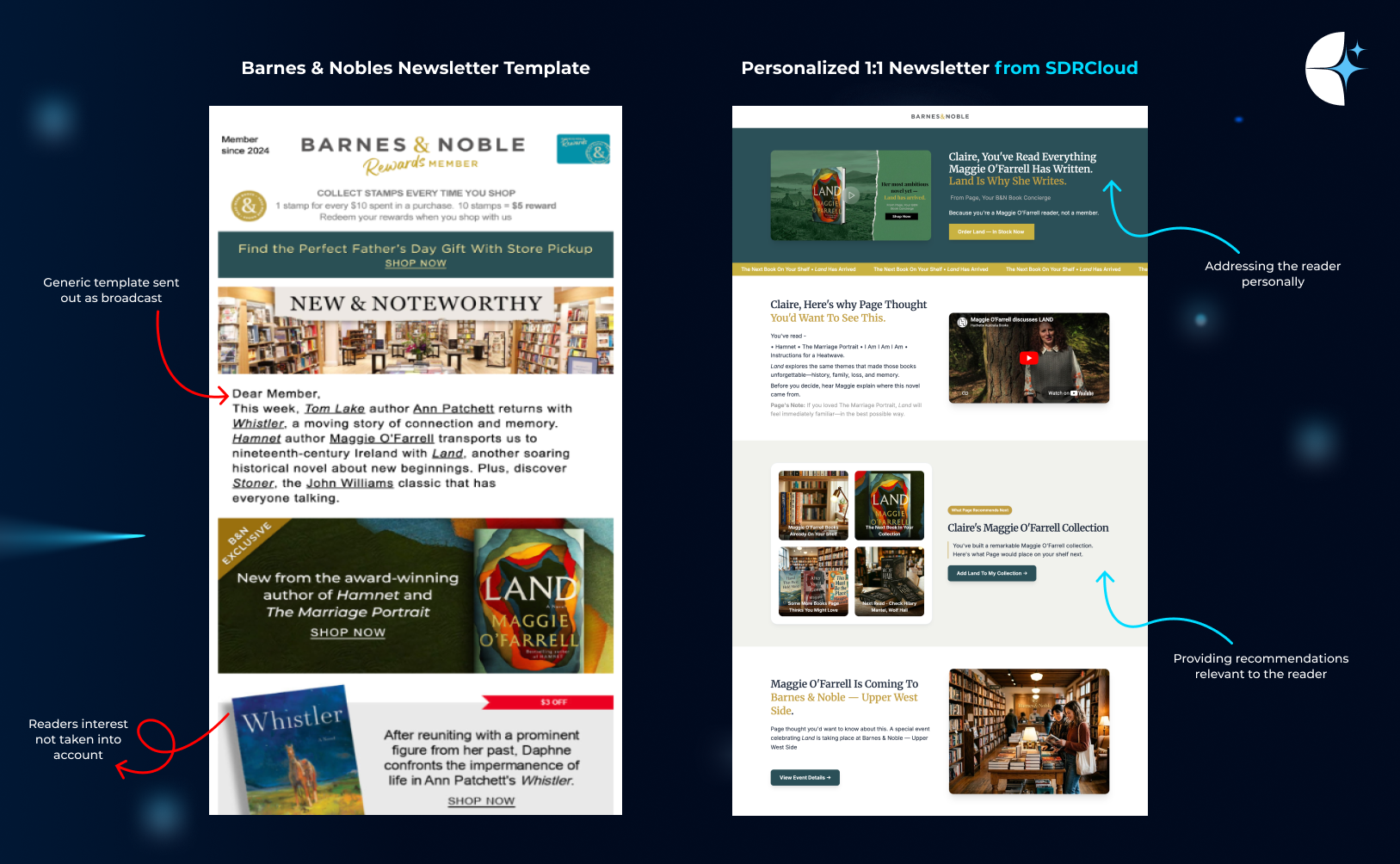
Industry benchmarks for standard broadcast retail email:
Open rate: 18–22%
Click-through rate: 2–3%
Conversion rate (purchase from email): 0.8–1.2%
Observed results from 1:1 personalised email campaigns with genuine purchase history segmentation (not just first name insertion, but content built from actual behaviour):
Open rate: 28–35% (first name + relevant subject line drives this)
Click-through rate: 8–14% (content relevance drives this — readers click when the email is genuinely about something they care about)
Conversion rate: 3.5–5.5% (the step-change — a reader who receives an email that references their specific reading history and surfaces the exact author they love converts at 4–6x the broadcast baseline)
For a campaign like the Maggie O'Farrell segment — targeting members with confirmed O'Farrell purchase history for the Land launch — the conversion differential is even more pronounced. These are not cold prospects. They are warm fans who have already spent money on this author. The email is the trigger, not the persuasion. The persuasion already happened across four previous purchases.
My prediction for this specific use case:
"These are projections based on published industry benchmarks, not Barnes & Noble's internal data." You probably already believe this is implied, but stating it explicitly closes the door.
The revenue per email sent — the metric that actually matters — is approximately 5.3x higher in the 1:1 version. Not because the product is better. Not because the offer is better. Because the email makes it unmistakably clear that it was written for this person, about something they specifically love, by a voice that remembers who they are.
The Voice Is the Differentiator
The single most underestimated element of 1:1 B2C email is not the personalisation of the content. It is the consistency of the voice.
Barnes & Noble's newsletter is not a voice. It is a broadcast with a masthead. There is no relationship. There is no memory. "Dear Member" is proof: the system does not know who it is talking to, and it does not pretend to.
"Page, Your B&N Book Concierge" is a voice. It has a point of view. It has memory. It speaks in the register of the books it recommends. It builds across touchpoints — the member who received Page's note about Land and then received Page's follow-up about Sebastian Barry is being cultivated, not just marketed to.
The concierge model — a persona with genuine taste, a consistent voice, and a memory for what every reader has bought — is not a chatbot. It is a brand relationship. And in a category like books, where the emotional connection between a reader and an author is one of the most powerful relationships in retail, the brand that makes that relationship visible and personal has a durable advantage over the brand that calls everyone "Member."
The Three Things Every B2C Brand Should Do This Week
1. Stop sending the same email to every subscriber. Segment by purchase history first. Even two segments — people who have bought in a category versus people who haven't — produces measurably better results than one broadcast. The data already exists.
2. Give the email a voice. Not a newsletter voice. Not a brand voice. A concierge voice — a persona that speaks in the register of the category, remembers what the member has bought, and writes to them as an individual. This is the single highest-leverage change any B2C email programme can make.
3. Use the signals that are already there. Purchase history. Browse behaviour. Rewards point balance. Proximity to the nearest store. These are not data projects. They are personalisation fields waiting to be populated. Every B2C brand with a loyalty programme is sitting on everything they need to transform their email performance. The execution infrastructure to use them at scale is what SDRCloud provides.
The Barnes & Noble Opportunity
Barnes & Noble serves millions of rewards members who have given them, through their purchase history, a precise map of what they love. The brand that builds a "Page" for every genre, every author fandom, every reading preference — and deploys it at scale through genuine 1:1 email infrastructure — does not need to compete on discounts. It competes on relationship. And in retail, relationship wins.
The irony is that Maggie O'Farrell writes about exactly this — the way people carry the people they love, the way memory becomes identity, the way being truly seen by another person changes everything.
Barnes & Noble has all the data to see their readers. They just haven't built the infrastructure to show it.
SDRCloud's Conversational Commerce infrastructure is available for B2C brands looking to move beyond broadcast email. The Asset Factory produces 1:1 landing pages and 1:1 video for every member in a loyalty programme, built from purchase history signals, deployable at scale.
Book a demo with Emma: https://calendly.com/gtm-call/30-minutes-with-emma-monro