Your HubSpot Data Already Knows Who's Ready. Native Sequences Don't Know What to Say to Them.

HubSpot is exceptional at knowing when someone's ready. Lifecycle stage changes, workflow triggers, lead scoring thresholds, form fills tied to specific content, all of it captured natively, all of it genuinely useful signal about where a contact actually is. The problem isn't the data. It's what HubSpot's own sequences do with it once a workflow fires.
A native HubSpot sequence, however well the trigger logic is built, still executes the same way underneath: a templated email, personalization tokens pulling in a first name and maybe a company field, sent from your own domain through your own sending reputation. The trigger might be sophisticated. What lands in the prospect's inbox rarely reflects that sophistication, because the output format was never built to carry it.
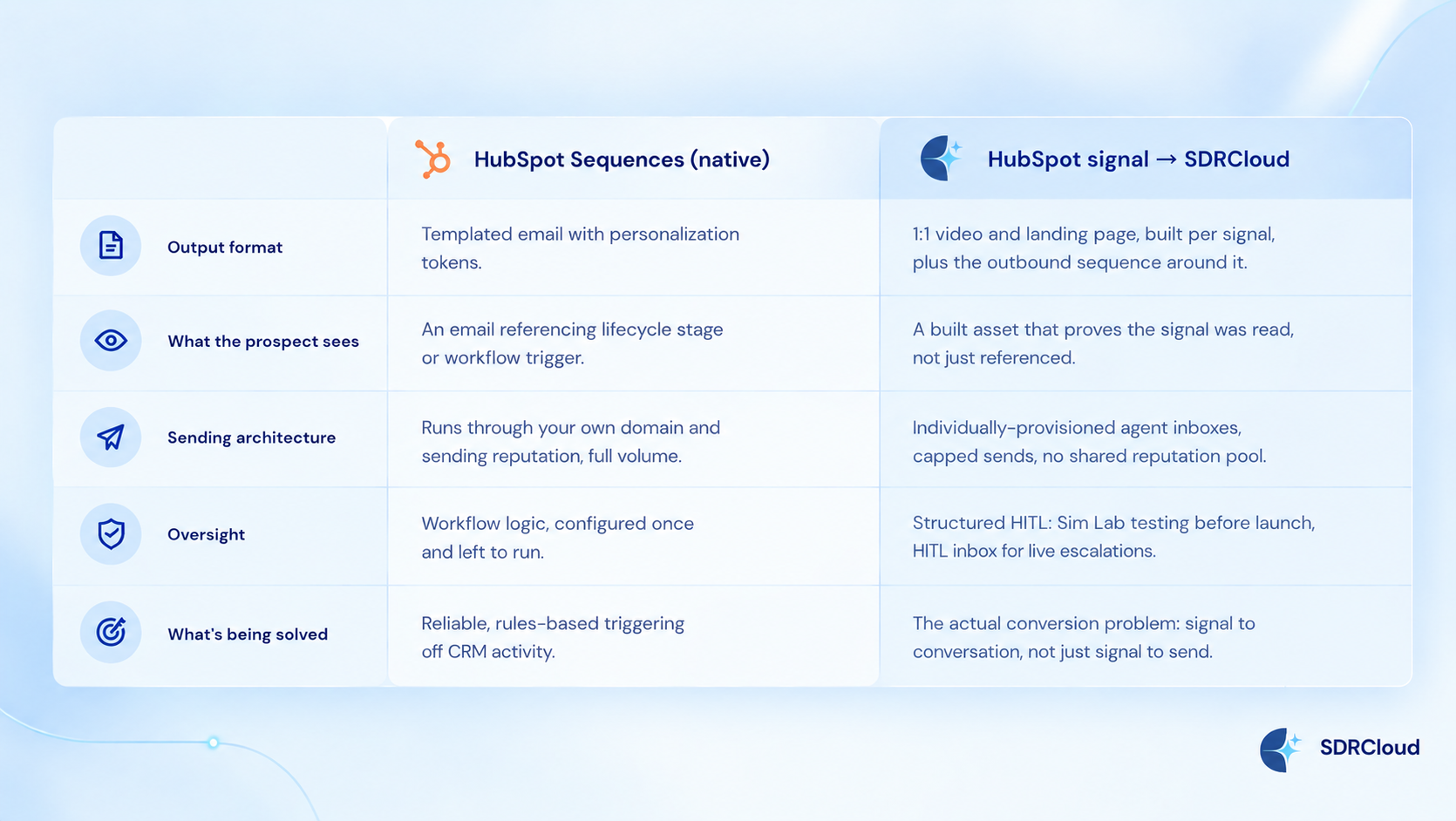
The core difference isn't trigger sophistication. HubSpot's workflow engine is genuinely good at deciding when to fire. It's what fires. A templated email, no matter how precisely triggered, is still a template, competing with every other email claiming to have noticed something about the recipient. A 1:1 video and landing page, built around the specific lifecycle event or behavior that triggered it, is something the prospect experiences as proof someone actually looked, not just proof your workflow logic executed correctly.
This isn't an argument for replacing what HubSpot already does well. Lifecycle tracking, lead scoring, workflow automation, that's the layer that tells you who's ready and when, and it's the reason the trigger exists to act on in the first place. What SDRCloud adds is the layer HubSpot's own sequences were never built to be: the execution engine that takes what your CRM already knows and turns it into something the recipient experiences as a genuine response to their specific situation, not a triggered template.
There's also a quieter cost to running high-volume nurture natively that rarely gets discussed openly: every sequence sent from your own domain, at scale, is volume your own sending reputation absorbs directly. HubSpot's native sending doesn't isolate that risk the way individually-provisioned agent inboxes do. The more aggressively you nurture at volume through your own domain, the more that volume itself becomes something to manage carefully, a tradeoff most teams don't fully price in until deliverability starts slipping on emails that have nothing to do with the nurture program at all.
Think of it as the difference between knowing exactly which contact just crossed into sales-qualified territory, and knowing exactly what to put in front of that contact in the next ten minutes that would make the moment count instead of just registering it. HubSpot answers the first question better than almost anything on the market. SDRCloud is built specifically to answer the second one, without the domain risk of running that volume through your own sending reputation.
If your team is already sitting on lifecycle and behavioral data more sophisticated than what your native sequences are doing with it, that gap, and the sending exposure underneath it, is the actual lever most HubSpot-native nurture programs are leaving unaddressed.