Your Next Event, Fully Booked: How to Turn 7,500 Free Credits Into Filled Booths and a Full Room
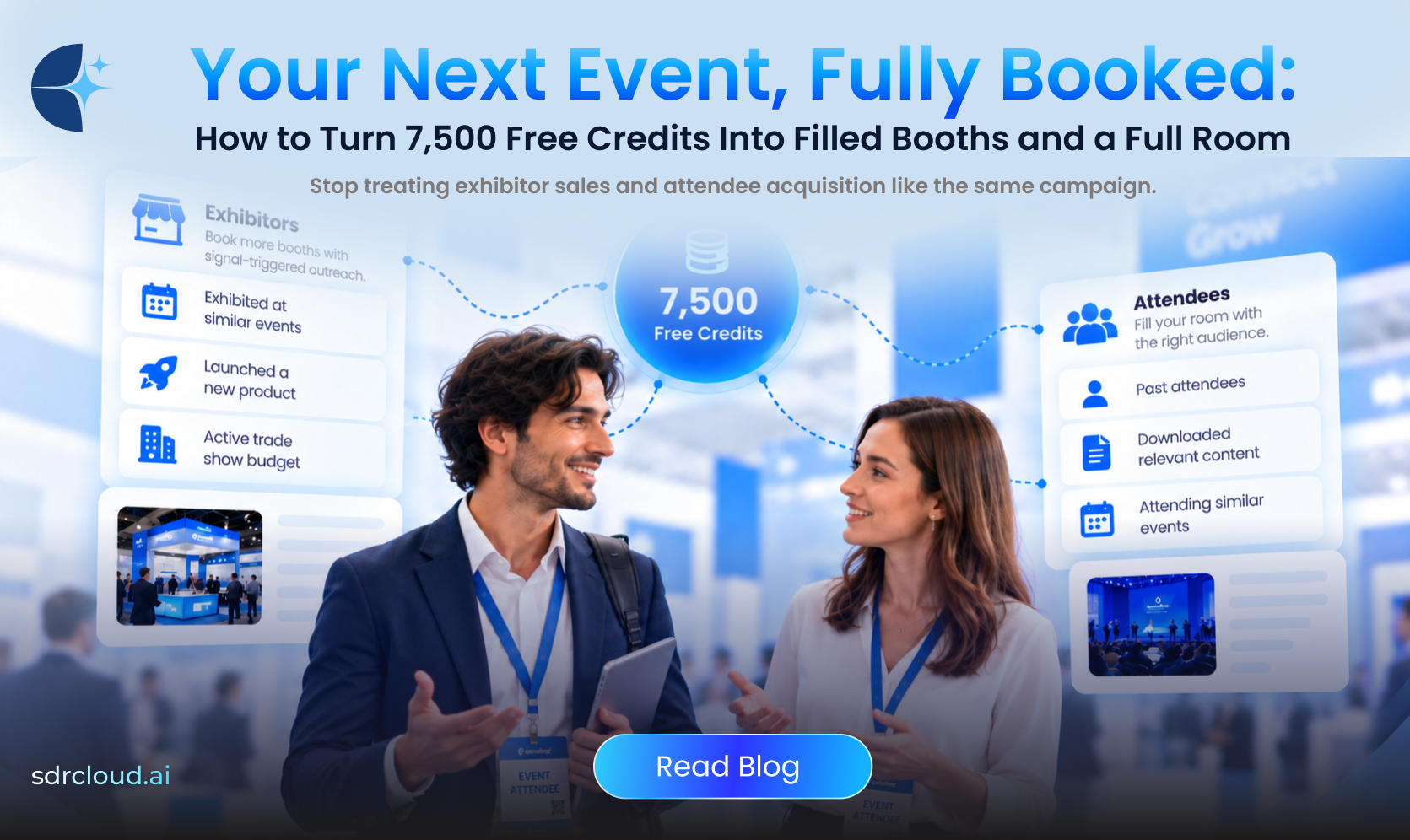
Every event organiser runs two outbound motions in the lead-up to a show, and they almost never get treated as the two distinct problems they actually are. Filling your exhibitor floor and filling your attendee seats require completely different signals, completely different messages, and completely different proof that you understood who you're talking to. Most organisers run one generic outreach playbook against both audiences and wonder why response rates lag on both sides.
We're giving event organisers 7,500 credits, free, to run signal-triggered outbound for their next event, split across both motions. Here's exactly how to use them, because "fill the show" isn't one campaign. It's two.
Motion 1: Booking Exhibitors
An exhibitor isn't deciding whether trade shows work in general. They're deciding whether this specific show, at this specific moment, is worth their booth budget instead of the other four shows competing for the same line item. That decision turns on signal, not a generic "reserve your booth" email that could have gone to any company in your category.
The signals worth building outreach around: a company that exhibited at an adjacent or competing show recently, which tells you they have active trade show budget and a buying pattern you can act on now, while it's still fresh. A company that just launched a new product or entered a new market, which means they have something specific to showcase and a real reason to want floor visibility right now, not generically. A company whose past attendees at your own event engaged heavily, sessions attended, booth traffic, but who hasn't re-booked yet for this cycle, which is a warmer signal than a cold prospect entirely.
Each of those signals becomes the basis for a 1:1 asset, a video and landing page built specifically around why this show, this year, fits what's happening in that company's go-to-market right now, not a generic sponsorship deck. That's a fundamentally different pitch than "booths starting at $X," because it's making the case for timing and fit instead of just availability.
Motion 2: Filling the Room
Attendee acquisition runs on a completely different signal set, because you're not selling a booth investment, you're selling two days of someone's calendar against everything else competing for it. The people worth prioritizing aren't a generic list of job titles in your category. They're the ones showing you they're already in-market for exactly what your event covers.
The signals here: someone who attended last year and whose company still fits your ICP, the single warmest possible signal, since they've already proven the event was worth their time once. Someone who downloaded content, a whitepaper, a session recording, a speaker's related material, tied to a topic track at your event, which tells you their interest already exists and just needs a reason to convert into a registration. Someone attending a comparable event nearby or in an adjacent category, which signals active engagement with the broader circuit your event competes in.
Each signal becomes a 1:1 asset built around what would actually make that specific person register, a video highlighting the session track tied to what they already downloaded, a landing page built around the speaker relevant to their signal, not a generic "here's our agenda" blast that assumes every recipient cares about the same three sessions.
Why the same credit pool, run two ways
Both motions draw from the same 7,500 credits, and that's deliberate, because most organisers have a marketing team sized for one campaign, not two parallel ones. Running both off signal-triggered execution instead of a manually built exhibitor sequence and a separately manually built attendee sequence means your team isn't doubling its workload to run both motions properly. The credits cover the 1:1 video and landing page generation and the outbound engine for both, so the split between exhibitor outreach and attendee outreach is a strategy decision, not a resourcing constraint.
Most events lose exhibitors and attendees for the same underlying reason: outreach that could have gone to anyone, sent to everyone, arriving with no signal that anyone understood who they were reaching or why now was the moment. Fixing that isn't about writing better generic copy. It's about building the asset around the actual signal, for the exhibitor deciding on budget and for the attendee deciding on their calendar, separately, because they were never the same decision to begin with.
Claim your 7,500 credits and we'll help you map both motions against your next event's timeline.