Your Salesforce Data Already Knows the Story. Every Sequencer Bolted to It Tells the Same Flat One.
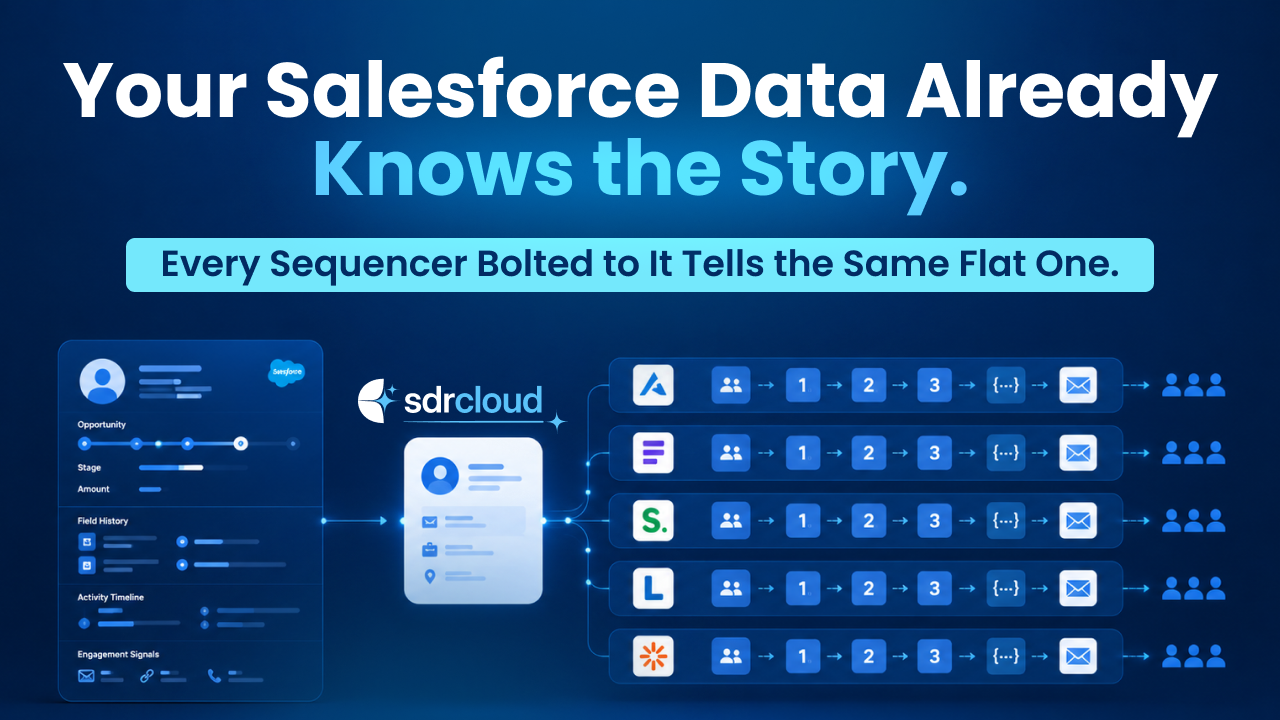
Open the sequencer landscape built around Salesforce and you'll find the same product, wearing different logos. A list of contacts, a sequence of steps, a template with merge fields, a send. Every major outbound sequencing platform on the market today, the ones built to bolt onto Salesforce and automate the manual cadence a rep used to run by hand, works this way: pull the record, run the steps, personalize the token, send. The category solved a real problem, the tedium of manually executing a five-touch cadence across hundreds of records. It solved it by making the manual process faster, not by making the output any different in kind.
That's the actual ceiling of the entire linear-sequencer category, and it's worth naming precisely because it's structural, not a quality gap between vendors. Every one of these tools treats a Salesforce record the same way: a static profile to run a sequence against. None of them were built to treat what's actually happening in that record, the specific opportunity stage, the specific field history, the specific activity pattern, as the actual basis for what gets sent. They automate the cadence. They don't reinterpret the data.
What's sitting in Salesforce that a sequencer never touches
Your Salesforce instance holds far more than contact and company fields. Opportunity stage changes. Custom field history built around your own sales process. Activity timelines showing exactly what's already been tried and how it landed. Account-level context accumulated over months or years of actual relationship history. A linear sequencer pulls a handful of those fields into a merge tag and discards the rest, because discarding the rest is what makes it a sequencer instead of something that has to interpret the record.
Side by side: linear sequencers (category norm) vs. Salesforce signal → SDRCloud
Linear sequencers (category norm)
Salesforce signal → SDRCloud
Output format
Templated email with merge fields, run in fixed steps
1:1 video and landing page, built per signal, plus the outbound sequence around it
What the prospect sees
An email referencing a name, company, maybe a stage
A built asset that proves the specific signal was read, not just referenced
Sending architecture
Runs through your own domain, shared cadence logic across all reps
Individually-provisioned agent inboxes, capped sends, no shared reputation pool
Signal used from Salesforce
Contact fields, basic stage trigger
Opportunity history, custom fields, activity timeline, account context
Oversight
Sequence steps configured once, run on schedule
Structured HITL: Sim Lab testing before launch, HITL inbox for live escalations
What's being solved
Faster manual execution of a fixed cadence
The actual conversion problem: signal to conversation, not just signal to send
Why "integrates with Salesforce" means something different here
Every sequencer in this category integrates with Salesforce, in the sense that they read and write records. That's table stakes, not differentiation. The actual question is what happens to the depth of what's in the record once it leaves Salesforce and becomes outreach. A sequencer integration means your CRM data feeds a merge tag. A signal-triggered integration means your CRM data feeds an asset built around what specifically changed, what specifically the history shows, what specifically makes this account's situation different from the one in the next row.
Think about a deal that stalled at a specific stage six months ago, with a specific objection logged in the activity history, and a signal now indicating renewed engagement. A linear sequencer re-engages that contact with the same generic "checking in" template it would use on a cold prospect with no history at all, because it has no mechanism for using the stall or the objection as anything other than background noise. A signal-triggered asset built around that exact history, referencing what actually happened and what's changed since, is a fundamentally different re-engagement than "just following up," and it's only possible because the execution layer was built to use the record's depth instead of three fields out of it.
The category didn't fail. It solved a narrower problem than it's now being asked to solve.
Linear sequencers exist because manually running a cadence by hand was genuinely tedious, and automating that tedium was worth building an entire category around. That problem is solved. The problem now is that Salesforce data has gotten richer, more contextual, more reflective of actual account history, faster than the sequencing layer built on top of it has evolved to use any of that richness. The gap between what's sitting in your CRM and what shows up in the outreach isn't a bug in any specific tool. It's the entire category's ceiling, reached by design, because none of them were built to interpret a record instead of running steps against it.