The Argument Every ABM Program Has and Never Resolves
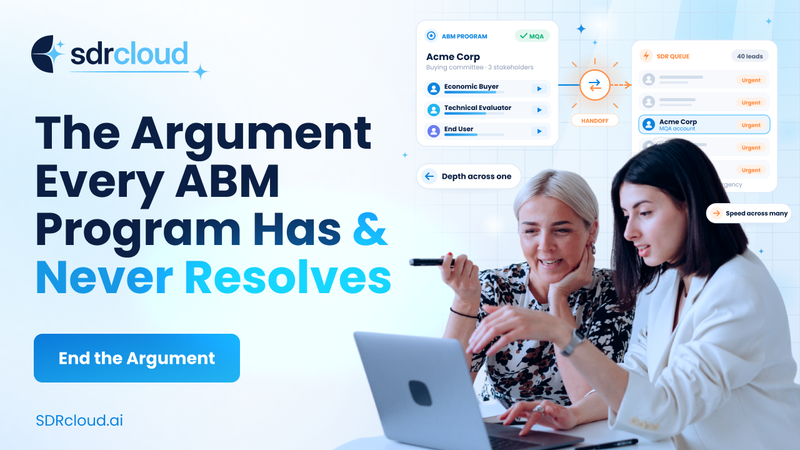
There's a specific, recurring friction inside almost every ABM program, and it rarely gets named directly because naming it means admitting the org chart itself is part of the problem. An ABM program manager spends weeks, sometimes months, doing real work to get an account to MQA: identifying the buying committee, mapping intent across multiple platforms, building account-specific content, orchestrating a genuinely coordinated multi-touch campaign. Then the account hits the threshold, gets handed to an SDR, and the actual execution that happens next looks nothing like the care that went into getting it there.
That's not usually a performance problem with the SDR. It's a structural mismatch nobody designed on purpose. SDRs are hired, trained, and compensated to work leads: individual contacts, fast follow-up, high volume, move to the next one. ABM handoff asks for something categorically different: patient, coordinated, multi-stakeholder engagement across an entire buying committee, where the economic buyer, the technical evaluator, and the end user all need something distinct, built with the same care the program manager put into getting the account here in the first place. One role was built for speed across many accounts. The other requires depth across one. Ask a person optimized for the first to suddenly deliver the second, at the exact moment an ABM program needs it most, and the friction that follows isn't anyone failing. It's two roles pulling in opposite directions, because they were never actually built to do the same job.
This is where the "argy bargy" between ABM and SDR teams actually comes from, and it's worth naming plainly instead of treating it as a communication problem to smooth over with better handoff documentation. The program manager is frustrated because the grinding, detailed work of actually adding value to a full buying committee, the specific thing MQA status was supposed to unlock, gets deprioritized the moment it lands in a rep's queue next to forty other leads with the same urgency stamp. The SDR isn't wrong either, they're doing exactly what their role rewards: moving fast, covering volume, treating every lead with roughly the same motion because that's the only way to hit a number built around speed. Neither side is failing at their job. The job itself was never built to deliver what ABM requires at the exact handoff point that matters most.
Whatever platform surfaced the signal, the handoff is where the value dies
If you're running 6Sense or DemandBase, both connect directly into SDRCloud, so the account intelligence and buying-stage detection that got an account to MQA doesn't have to restart as a generic lead the moment it changes hands. If you're running RollWorks or Terminus, the same underlying problem applies even without that direct connection: whatever platform did the hard work of identifying the committee and the signal, the execution layer downstream of it usually has no way to honor that depth once a human has to personally act on it across every stakeholder.
That's the actual gap. It was never that ABM platforms fail to surface good signal. It's that turning "this buying committee is ready" into five individually relevant experiences, delivered with the same care as the research that identified them, was never a job one person could do at scale, no matter how good they are at it.
Give every stakeholder the experience an ABM manager already dreams of giving them
Here's what changes when that execution doesn't depend on SDR bandwidth. Instead of one rep trying to personally craft something relevant for the economic buyer, the technical evaluator, and the end user, on top of everything else in their queue, each stakeholder on the buying committee gets a genuine 1:1 asset, a video and landing page built around their specific signal and role, deployed the moment the account hits the threshold the ABM team worked to reach. Not a generic sequence with a stakeholder's name swapped in. The actual, individually-built experience a program manager would build by hand for every member of the committee, if they had unlimited time and a dedicated writer for every single account.
That's the resolution to the argy bargy, and it's not a mediation exercise between two teams with different incentives. It's removing the requirement that a time-constrained human personally deliver something that was always better suited to signal-triggered execution in the first place. The SDR isn't replaced. Their job shifts to exactly what a rep is actually good at: the live conversation, the objection handling, the judgment call once a stakeholder responds, instead of trying to hand-craft five separate assets for five separate people on top of a full pipeline of other accounts.
What this makes newly measurable
There's a real, useful side effect here for anyone who's had to defend an ABM budget in front of a skeptical CRO. When every stakeholder's touch is a specific, built asset tied to a specific signal, you're no longer reporting influenced pipeline in the aggregate, an account touched by a dozen assets getting full credit for all of them. You can trace which specific asset, to which specific person, preceded which specific movement in the deal. That's a smaller, more honest number than most ABM dashboards currently produce. It's also the only version of that number that survives a buyer's diligence, or a board member's follow-up question, because it's built on what actually happened rather than what ran alongside it.
The friction between ABM and SDR teams isn't a training problem, and it isn't a personality problem between two functions that see the account differently. It's what happens when the last mile of a genuinely sophisticated program still depends on one person's bandwidth to deliver something that was always meant for every member of a buying committee, not just whichever ones a rep had time to get to.