The Buying Committee Isn't Moving Together. Stop Sequencing Like It Is.
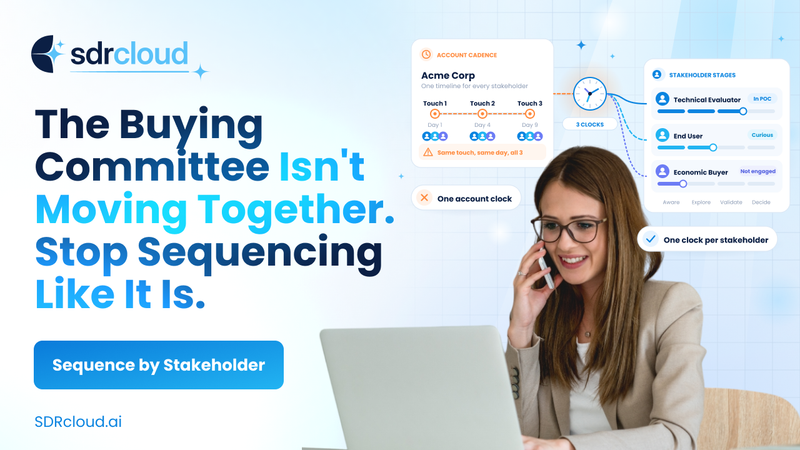
Most ABM cadences are built around a single account-level timeline: touch one, touch two, touch three, delivered to every stakeholder on roughly the same schedule, as if the economic buyer, the technical evaluator, and the end user are all standing at the same point in the same decision.
They're not, and treating them as though they are is a quieter failure than the coordination problem everyone talks about. The technical evaluator might already be deep into a proof-of-concept, asking detailed implementation questions. The economic buyer might not have engaged with anything yet, still needs the business case made from scratch. The end user might be somewhere in between, curious but not yet convinced this solves their actual day-to-day problem. Same deal, same account, three completely different readiness stages, happening simultaneously.
Sequence all three off one account-level cadence, and you send the technical evaluator content too basic for where they already are, while the economic buyer gets a pitch built for someone much further along than they actually are. Neither lands, not because the messaging was wrong in the abstract, but because the timing assumption underneath the whole cadence was wrong. The committee was never one clock. It's several, running at different speeds, and most account-based sequencing quietly assumes they're synchronized because synchronizing them is easier to build than tracking each one separately.
The alternative is treating stakeholder-stage, not account-stage, as the actual unit of sequencing. The technical evaluator's next asset should reflect where their specific evaluation actually is, not where the account as a whole is trending. The economic buyer's next touch should meet them at genuinely early-stage, even while their technical counterpart is three stages ahead on the same deal.
This is a harder motion to run manually, because it means tracking multiple independent timelines inside a single account instead of one shared one. It's also the actual reason a lot of technically excellent evaluations stall at the economic buyer stage, or a lot of well-sold economic buyers get lost when the technical evaluation drags because nobody adjusted the cadence to where that specific stakeholder actually was. The deal didn't stall because ABM failed. It stalled because three different clocks got treated as one.