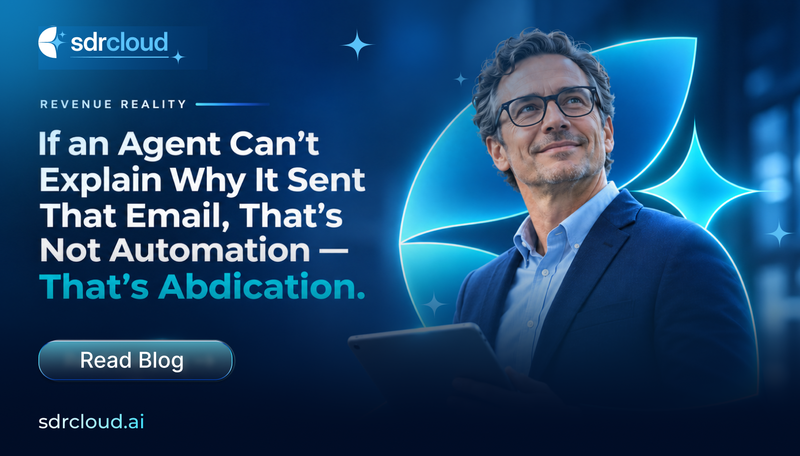
If an Agent Can't Explain Why It Sent That Email, That's Not Automation — That's Abdication
Ask any AI SDR vendor a simple question: why did your agent send that specific email, to that specific person, at that specific moment? Not "what's your personalization technology." Not "how does targeting work." Just: why that email, why then, why them.
Most of them can't answer it. And I don't mean they won't — I mean the system genuinely doesn't retain the answer anywhere. The agent generated something, it went out, and the reasoning behind it evaporated the moment the send completed. Ask why, and you get a shrug dressed up as a technical explanation: "the model determined it was appropriate." That's not an answer. That's a system telling you it doesn't keep receipts.
I think this is the actual gap in this category, and it's more important than volume, more important than reply rate, more important than any of the numbers everyone leads with. Accountability isn't a compliance checkbox you bolt onto a platform to satisfy someone in legal. It's the actual product. If you can't get a straight answer for why an action was taken, you don't have an accountable system — you have an unaccountable one that happens to have good manners about it.
Here's how you can tell the difference, because it isn't a matter of taking a vendor's word for it. Ask what happens the day something goes wrong — not hypothetically, specifically. A prospect gets an email they shouldn't have. Wrong tone, wrong timing, wrong read on a signal that should've triggered silence instead of outreach. What happens next tells you everything.
In an unaccountable system, "what happens next" is: someone notices, someone's embarrassed, and nobody can actually reconstruct why it happened, because the system wasn't built to retain that. You get an apology instead of an explanation, because an explanation isn't available. The mistake gets fixed going forward in the vaguest possible way — "we've adjusted the model" — because nobody can point to the specific decision that produced it.
In an accountable system, "what happens next" is a real answer: this is the signal the agent read, this is why it interpreted it that way, this is who reviewed it, this is what changed. Not because someone assembled that after the fact under pressure — because the system was built from the start to make that traceable. The explanation isn't reconstructed. It's retained.
That distinction is the whole thing. Compliance theater is when you build a review step so you can say a human was "involved," without the system actually preserving why any decision was made. It's a rubber stamp with a paper trail that leads nowhere useful. Real accountability is when the reasoning behind an action is available on request, not manufactured after the fact to satisfy the question.
I'd go further: I think a lot of what gets marketed as "human-in-the-loop" in this category is compliance theater wearing accountability's clothes. A human clicking approve on something they didn't meaningfully evaluate isn't oversight. It's a signature on a form nobody read. If the reviewer can't tell you why they approved it, they weren't actually the checkpoint they were positioned to be — they were decoration.
The test I'd apply to any AI SDR platform, including ours, is simple: pick any email it sent last week and ask why. Not what technology powered it. Why that one, to that person, at that time. If the answer is specific — this signal, this read, this reasoning — you're looking at a system that treats accountability as load-bearing. If the answer is vague, or requires someone to guess after the fact, you're looking at a system where the explanation was never the point. The send was the point. The explanation was theater, if it existed at all.
Autonomous doesn't mean unaccountable, and I've said that before. But I think the sharper version of the point is this: accountable doesn't just mean a human was technically in the loop somewhere. It means the reasoning survives the send. If it doesn't — if the only thing you get when you ask "why" is a shrug — that's not a smaller version of automation. That's automation with the one thing that made oversight meaningful quietly removed, and a compliance checkbox left standing in its place to make the absence look intentional.