The SDR Job Isn't Disappearing. It's Promoting.
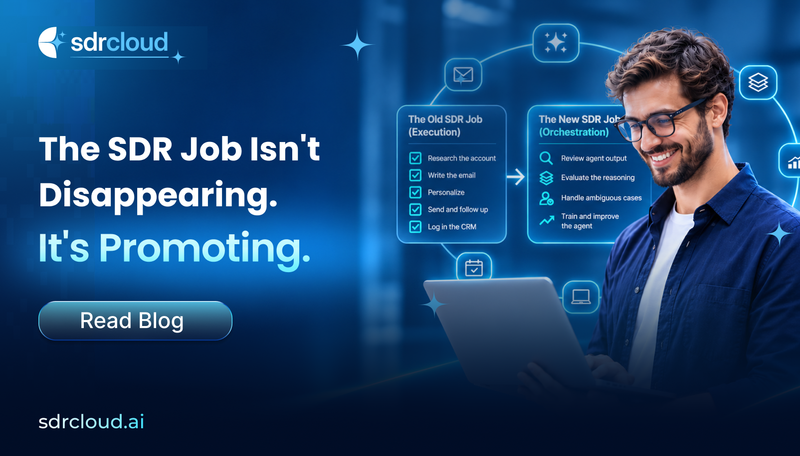
Every headline about AI SDRs asks the same question: how many jobs does this eliminate? I think that's the wrong question, and I think asking it is why so many sales leaders are approaching this backwards.
The better question is: what does a good SDR's job actually become once the parts that burned them out are gone?
Let's be honest about what the job has looked like for years. Research the account. Write the email. Personalize it just enough to not get flagged as spam. Send it. Wait. Follow up. Handle the objection with a script that doesn't quite fit the situation. Log it in the CRM. Do that sixty times a day, every day, and wonder why the tenth email of the morning sounds nothing like the first one did. That job burns people out not because they're bad at it — because most of it is typing, and typing at that volume degrades no matter who's doing it.
Automate the typing, and here's what's actually left: judgment. The reads that don't fit a script. The escalations that need a human call. The moments where an agent did something ambiguous enough that someone with actual context needs to weigh in. That's not a smaller job than the one before it. It's the part of the old job that was always the real skill — it was just buried under forty emails a day of execution work surrounding it.
I'd call that a promotion, not a demotion, and I mean that literally in terms of what the role requires. A typist executes. An orchestrator directs, reviews, and corrects. Those aren't the same skill, and the second one is harder to be good at, not easier.
Here's what that actually looks like day to day, because I don't want to leave this as an abstraction. Instead of writing the fortieth email themselves, an SDR is reviewing what an agent produced and deciding whether it's actually right for this account — not rubber-stamping it, evaluating it. Instead of guessing whether a sequence is going to land before it's live, they're watching it run through simulation first and deciding whether the agent's read on a signal was the right one. Instead of handling every reply personally, they're sitting in front of the decisions that got surfaced specifically because they were ambiguous enough to need a person — and when they override one, they're not just fixing a single email, they're shaping how the agent handles the next similar case. That's not oversight for the sake of oversight. That's actual management, of an actual system, with actual consequences for getting it wrong.
That's a harder job to hire for, not an easier one. You can train someone to write sixty adequate emails a day. It's much harder to train someone to look at an agent's output and correctly judge whether the reasoning behind it holds up — to catch the mistake that looks fine on the surface but is wrong for reasons that take real account context to see. The execution job rewarded volume and consistency. The orchestration job rewards judgment and pattern recognition, the same instincts that used to only belong to your best rep, the one who could never scale past however many accounts they could personally hold in their head.
I think this is the part the "replace your SDRs" pitch gets fundamentally wrong, and not just as a matter of framing. It assumes the valuable part of the job was the execution — the writing, the sending, the volume — and that once you automate that, there's nothing left worth paying someone for. That's backwards. The execution was never the scarce skill. Good judgment under ambiguity was always the scarce skill, and it was the part you could least scale, because your best person could only personally review so much before something slipped.
Automate the part that didn't require judgment, and you don't eliminate the job. You concentrate it. What's left is a smaller number of people doing exactly the part that was always hardest to hire for and hardest to scale — which means what's left is, if anything, more valuable per person than what came before it, not less.
So when someone asks whether AI is coming for the SDR job, I don't think the honest answer is yes or no. I think the honest answer is: it's already come for the forty emails a day that were never really the job to begin with. What's left is the part that was the job all along. We just used to bury it under enough typing that most people never got to spend their time doing it.