Things We Don't Do at SDRCloud
Every AI SDR company is selling you the same fantasy: fire your reps, deploy an agent, watch pipeline fill itself while you sleep. Full autonomy. Zero humans required.
We could have built that. We want to be direct about this: full autonomy is the easier product to ship. No simulation step to build. No review inbox to design. No training loop to maintain. Just let the agent run and call the absence of a checkpoint "efficiency."
It's a faster roadmap, a cleaner demo, and a worse product.
We didn't build it. Here's exactly what we refused, and what we put in its place instead.
The five things we said no to:
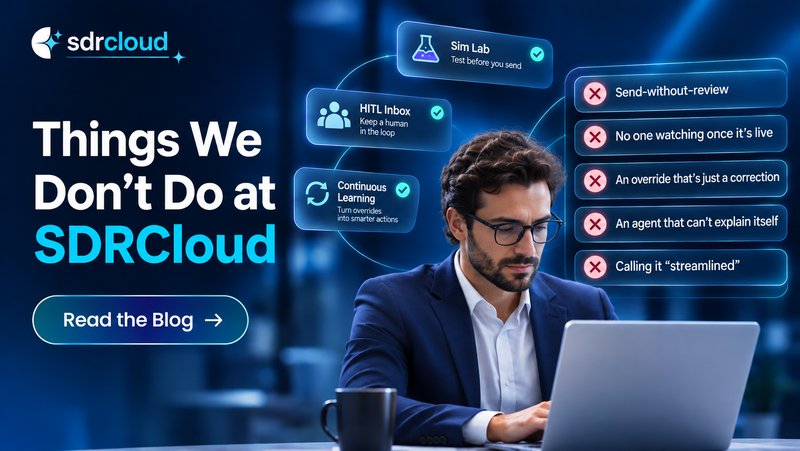
- Send-without-review
- "No one watching once it's live"
- An override that's just a correction, not a lesson
- An agent that can't explain itself afterward
- Calling any of the above "streamlined"
The easy version of this product lets an agent go straight from "generated" to "sent" with nothing in between. We refused that.
Instead, before an agent ever touches a live prospect, it runs through Sim Lab, a simulation environment where the full sequence, the personalization output, and the agent's likely responses get tested against realistic scenarios first.
We find the tone that reads wrong, the response logic that misfires on an edge case, the sequence that would've kept firing at someone who'd gone quiet for the wrong reason, in a sandbox. Not in a live inbox, where the damage is already done and there's no undo.
We didn't ship "no one watching once it's live."Plenty of platforms treat launch as the finish line: configure it once, let it run, check the dashboard for green numbers. We refused that too.
Once a campaign is live, ambiguous decisions, escalations, and replies that don't cleanly match a script get surfaced in the HITL inbox for a real person to review, approve, or override.
That's a structural choice we made when the easier one was to let the agent handle everything and call whatever happened "the system working as intended."
We didn't let an override just be a correction and nothing more.This is the one we think matters most, because it's the difference between compliance theater and an actual feedback loop.
Some platforms that do have a review step treat it as a rubber stamp: a human clicks approve, nothing changes, the agent behaves identically next time. We refused to build it that way.
When someone overrides a decision in the HITL inbox, that outcome trains the agent's handling of the next similar situation. Our refusal to accept "reviewed but unchanged" as good enough is what makes the loop actually close instead of just existing for show.
We didn't ship an agent that can't explain itself afterward.This is the refusal underneath the other three, and it's worth naming on its own. It would be easy to let the reasoning behind a send evaporate the moment it goes out, generate, send, forget, and answer any question about it later with a shrug dressed up as a technical explanation.
We refused that too. Every decision an agent makes is traceable back to the specific signal it read and the specific reasoning behind it, not reconstructed after the fact under pressure once something's already gone wrong.
If an agent can't explain why it sent something, that's not automation. That's abdication with a nicer word attached to it.
We didn't call the absence of these things "streamlined."This is the marketing refusal underneath all the product refusals. It would be easy to describe a lack of simulation, a lack of review, a lack of traceability as "frictionless" or "hands-off," and plenty of vendors do exactly that, because it sounds like a feature. We won't describe it that way, because it isn't one. It's the absence of the places where accountability actually lives.
What the five refusals actually add up toIf an agent sends something wrong, there's a specific answer to who could have caught it, where, and why it happened:
- Someone reviewed it in simulation before it ever launched.
- Someone was positioned to catch it in the HITL inbox if it went sideways once running.
- Someone can trace exactly what it read and why it decided what it decided.
Not in theory. In a dashboard, doing a specific job, every day. That answer only exists because we said no to the versions of this product that don't have one.
So here's our actual position: autonomous doesn't mean unaccountable.
Every time a platform chooses the faster, cleaner, more "streamlined" version of this product, what they're actually choosing is to not build the place where accountability would live. That's not a smaller decision than the one to build the agent in the first place. It might be the more important one.
Ask whoever's selling you the next AI SDR platform what they said no to.
If the honest answer is "nothing, we shipped everything the technology allows," you already know everything you need to know about what you're buying.