The Recruitment Marketing Gap Nobody Names: Great Candidate Content, Generic Delivery
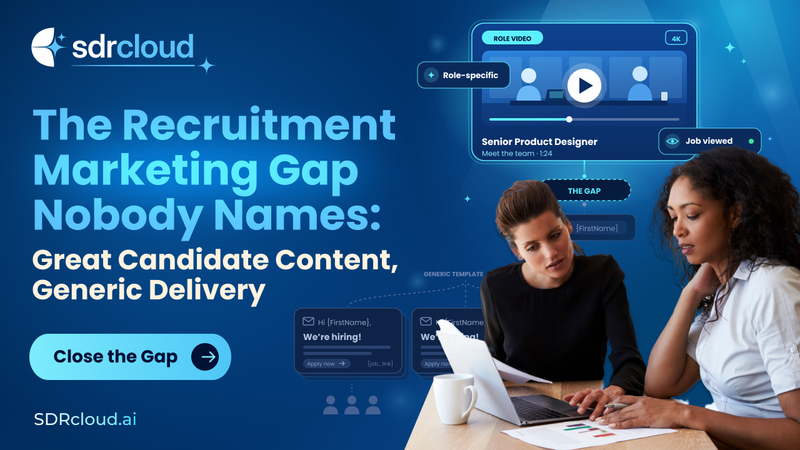
Recruitment marketing has spent real budget solving the content problem. High-production job videos, branded candidate landing pages, programmatic ad spend pushing postings to exactly the right channels. The content and the targeting have both gotten genuinely sophisticated.
Then a candidate clicks through, and what happens next reverts to the oldest pattern in the category: a generic "we're hiring" email, or a templated follow-up that could have gone to anyone who ever applied to anything. The investment in great content doesn't disappear. It just stops mattering the moment execution takes over, because nothing downstream was built to use it per candidate, per signal.
That's the actual gap in recruitment marketing right now. Not a content problem. A delivery problem.
Your Recruitment Marketing Videos Deserve a Delivery Layer That Matches Their Quality
If you're producing candidate videos through JobPixel, you already have exactly the kind of asset that should anchor a signal-triggered outreach motion: high-value, role-specific video content built to actually show a candidate what the job and team are like, not a stock photo and a bullet-pointed job description.
Here's where that value usually gets lost: the video exists, it's genuinely good, and then it gets dropped into a generic email blast or sits on a static job page waiting for someone to find it. The production quality doesn't translate into delivery quality, because nothing connects "this specific candidate showed this specific signal" to "send them the specific video built for this exact role."
SDRCloud is built to be that missing layer. A candidate signal, a job view, an application start, a specific skills match, triggers outreach that deploys the actual JobPixel video for that role directly to that candidate, not a generic recruiting email with a generic link buried in it. The video does the work it was built to do: showing, not just telling. SDRCloud's job is making sure it actually reaches the candidate at the moment it would matter most.
Turning Programmatic Ad Signal Into Something Better Than a Retargeting Ad
If you're running AppCast or similar programmatic job advertising, you already have granular signal most recruitment teams underuse: which candidates clicked an ad, which started an application and dropped off, which roles are getting clicks without conversions.
Today, that signal usually feeds one of two things:
A retargeting ad, which is still a broadcast, just aimed more precisely
Nothing at all, because the drop-off data sits in a dashboard nobody actively acts on
A candidate who clicked your ad and started an application, then abandoned it, isn't a cold prospect. They're a warm one who hit friction. That's a fundamentally different re-engagement opportunity than a retargeting ad assumes.
Here's the alternative: an AppCast (or equivalent programmatic) signal, specifically an application drop-off, triggers a 1:1 asset built around that exact role and that exact point of hesitation, not another ad impression hoping they click again. If JobPixel produced a video for that role, this is exactly the moment it gets deployed, directly, to the specific candidate who already showed real intent.
Your Candidate CRM Already Knows Who's Worth Re-Engaging
If you're running a candidate relationship platform like Beamery, Phenom, or Symphony Talent, you're sitting on a dormant pool of candidates who applied before, weren't right for that specific role, and were tagged for future consideration. Most of that pool never hears from you again until a recruiter manually remembers to check.
The signal is already there:
A candidate previously applied to a similar role
A new opening matches their tagged skills or experience
Enough time has passed that a fresh, specific outreach makes sense
That combination, a real signal plus a real reason, is exactly the trigger structure the Asset Factory is built around. Instead of a generic "we have a new opening, are you still interested?" email, the candidate gets outreach built around the specific new role and why it matches what they showed interest in before, ideally with the actual JobPixel video for that role attached, not a rediscovery of the same job description they already read months ago.
Programmatic and Aggregator Platforms: The Same Signal, the Same Opportunity
The same logic extends to other programmatic and job-distribution platforms in this space, Joveo, PandoLogic, and Recruitics among them: click and application signal exists, it's granular, and almost none of it currently triggers anything more specific than a retargeting ad or a generic nurture sequence. Wherever that signal already exists in your stack, it's a candidate for the same treatment described above, not a platform-specific exception.
Why Recruitment Marketing Has the Same Broadcast Problem as B2B Outbound, Just Less Discussed
Recruitment marketing rarely gets framed alongside B2B or B2C outbound, but the underlying failure is identical: real signal, genuinely good content, and an execution layer in between that flattens both into something generic by the time it reaches the person it's for.
A candidate deciding between your opening and three others is making a decision the same way a B2B buyer decides between vendors, on whether what they received felt like it was actually about them. A job video built specifically for the role, delivered at the exact moment a candidate signal indicates real interest, is a fundamentally different candidate experience than the same video sitting on a static page, or a generic follow-up email pretending to reference it.
If your recruitment marketing stack, JobPixel, AppCast, Beamery, Phenom, Symphony Talent, Joveo, PandoLogic, or Recruitics, is already producing content and signal this good, the opportunity isn't more content. It's an execution layer that finally delivers it like it was built for one specific person, because it was.